Your Cart is Empty
Start shopping

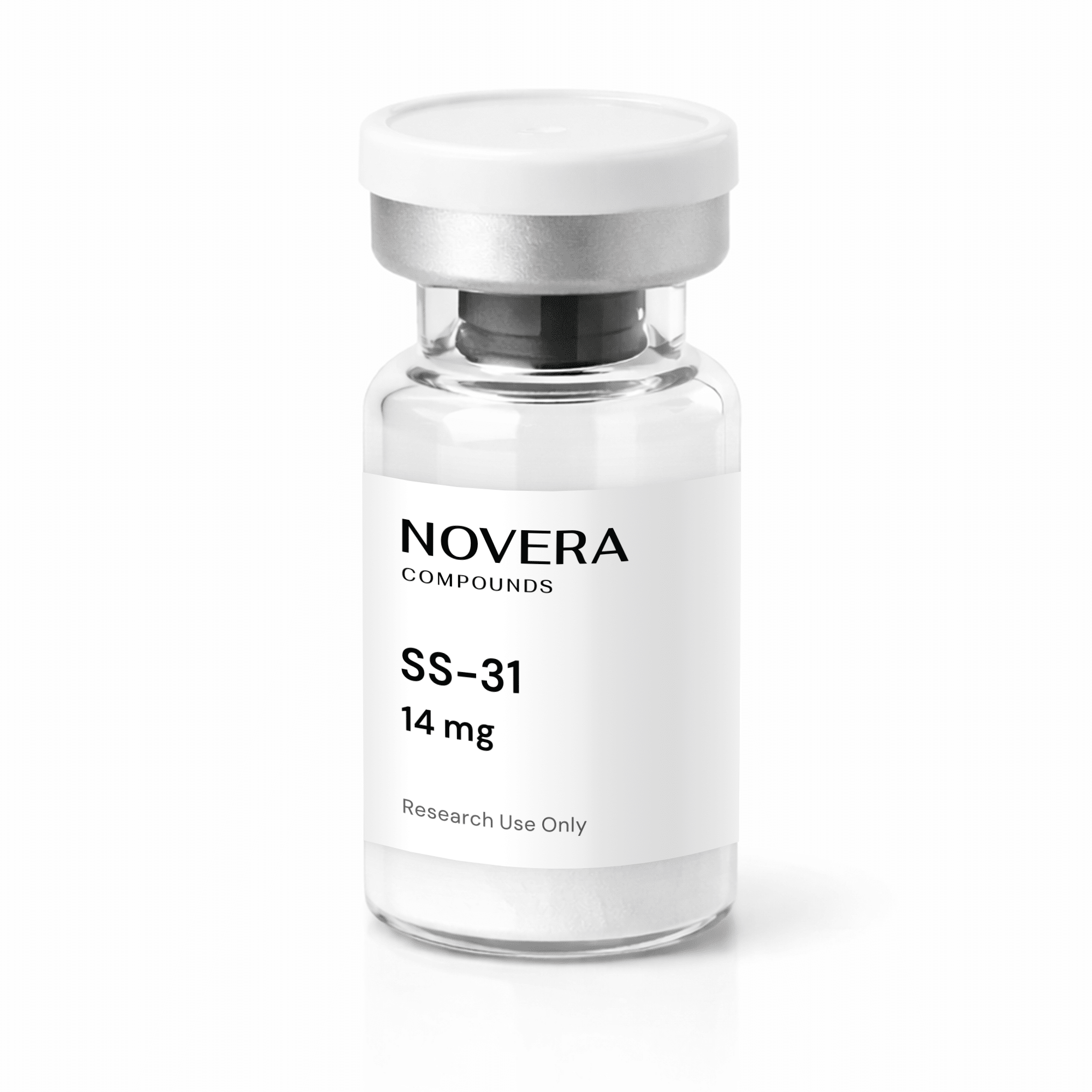
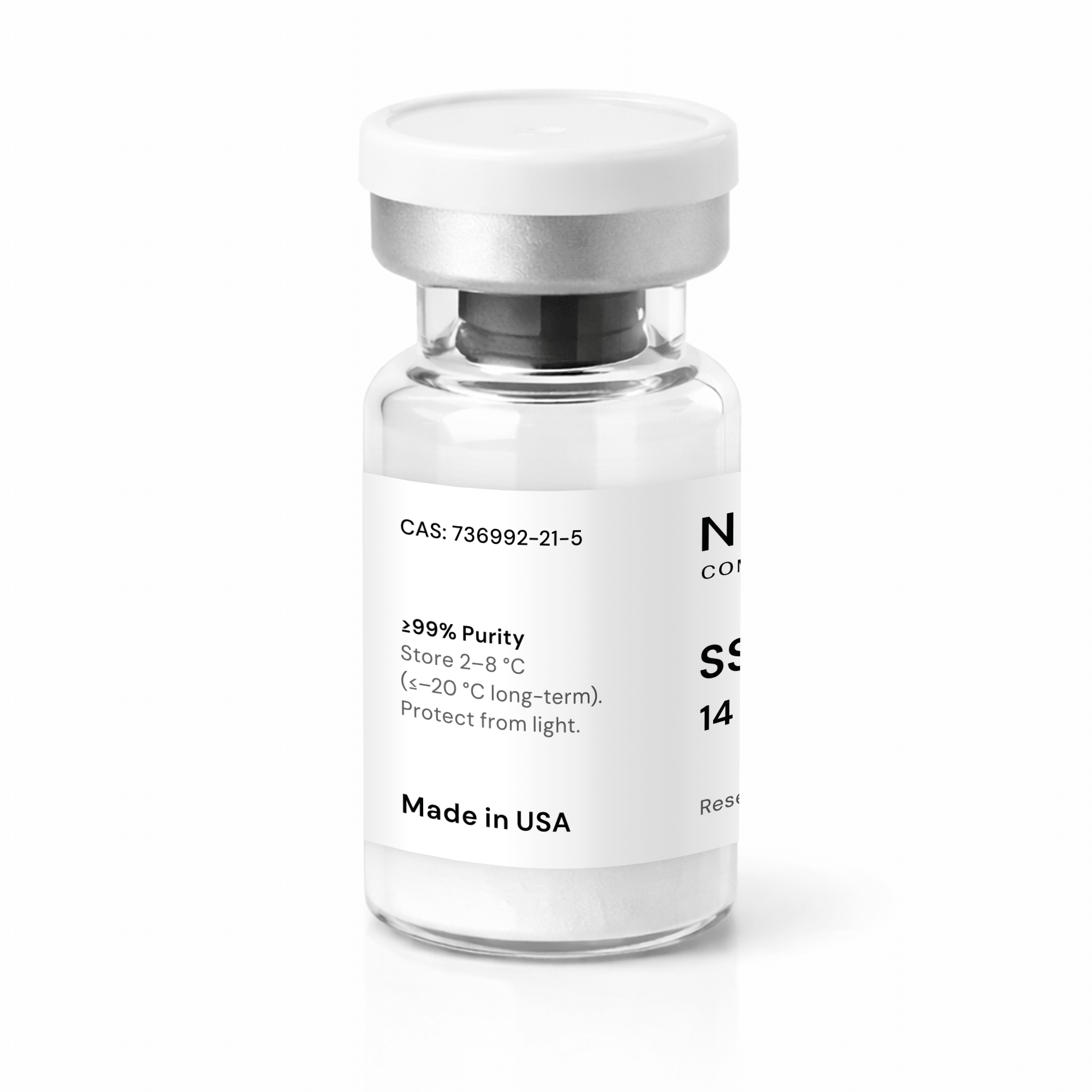
SS-31 (14mg)
Coming Soon
This peptide will be available soon. Join the waitlist to be notified when it launches.
Product description
What is SS-31 (14mg)?
SS-31 (14mg), also known as Elamipretide or MTP-131 in scientific literature, is a synthetic tetrapeptide designed for laboratory research. It is composed of four modified amino acids arranged in the sequence D-Arg-dimethyl-Tyr-Lys-Phe-NH₂. This peptide is studied for its potential to interact with mitochondrial membranes, particularly in experiments investigating cellular energy production and oxidative stress regulation.- Chemical Formula: C₃₂H₄₉N₉O₅
- Molecular Weight: 639.8 g/mol
- CAS Number: 736992-21-5
What are the key features of SS-31 (14mg)?
- Synthetic tetrapeptide composed of four amino acids
- Purity typically ≥95%, verified by HPLC and mass spectrometry
- Supplied as 14 mg lyophilized peptide in a sealed research vial
- Studied in mitochondrial signaling and cellular energy metabolism research
- For laboratory research use only
How is SS-31 (14mg) synthesized?
SS-31 (14mg) is produced by solid-phase peptide synthesis (SPPS), a widely used method that enables precise assembly of peptide chains. During this process, protected amino acids are sequentially added to a solid support until the final peptide structure is formed. After synthesis, the peptide is purified using high-performance liquid chromatography (HPLC) to ensure high purity. Structural identity and molecular weight are verified using mass spectrometry (MS). The purified peptide is then lyophilized to improve stability during storage and transportation.What is SS-31 (14mg) being studied for? What are its possible benefits?
SS-31 (14mg) has been studied for its potential role in mitochondrial biology and cellular energy regulation. Mitochondria produce cellular energy through oxidative phosphorylation, making compounds that influence mitochondrial function valuable for research into metabolic processes. Research areas involving SS-31 include:- Mitochondrial function research
- Cellular energy metabolism studies
- Oxidative stress and mitochondrial signaling models
- Cardiovascular and muscle tissue experimental models
- Age-related cellular metabolism investigations
How does SS-31 (14mg) work in research studies?
In research models, SS-31 (14mg) is studied for its ability to interact with mitochondrial membranes, particularly with lipid components such as cardiolipin, which are essential for maintaining mitochondrial structure and function. By associating with mitochondrial membranes, SS-31 may influence processes involved in cellular energy production and oxidative stress regulation. Researchers are investigating how this interaction may affect mitochondrial stability and signaling pathways involved in cellular metabolism. These mechanisms are still under investigation in laboratory studies and have not been established as clinical outcomes.What dosing information exists for SS-31 (14mg)?
Research on SS-31 (14mg) has primarily been conducted in preclinical studies using cell cultures and animal models. In vitro experiments typically evaluate peptide activity at nanomolar to micromolar concentrations to study mitochondrial responses. In animal research, dosing has been explored in the microgram-per-kilogram (µg/kg) range, depending on the experimental model and study objectives. Since SS-31 is a research compound, no standardized human dosing guidelines exist, and its use is limited to laboratory research settings.How should SS-31 (14mg) be stored and handled?
- Store under temperature-controlled conditions per laboratory protocol and certificate of analysis.
- For extended storage, follow temperature conditions specified in the product certificate of analysis.
- Protect the lyophilized peptide from light, heat, and moisture.
- Room-temperature exposure during transport is acceptable for short periods.
- Once reconstituted, store under appropriate temperature-controlled conditions per laboratory protocol for short-term use.
- Avoid repeated freeze-thaw cycles to preserve peptide integrity.
- Refer to the batch certificate of analysis for batch-specific stability data.
Where can I read more research about SS-31 (14mg)?
Researchers interested in SS-31 and mitochondrial peptide research may consult the following publications:- Zhu Y, Luo M, Bai X, et al. SS-31, a Mitochondria-Targeting Peptide, Ameliorates Kidney Disease. Oxid Med Cell Longev. 2022;2022:1295509. Published 2022 Jun 6. doi:10.1155/2022/1295509
- Du X, Zeng Q, Luo Y, et al. Application research of novel peptide mitochondrial-targeted antioxidant SS-31 in mitigating mitochondrial dysfunction. Mitochondrion. 2024;75:101846. doi:10.1016/j.mito.2024.101846
- Russo S, De Rasmo D, Signorile A, Corcelli A, Lobasso S. Beneficial effects of SS-31 peptide on cardiac mitochondrial dysfunction in tafazzin knockdown mice. Sci Rep. 2022;12(1):19847. Published 2022 Nov 18. doi:10.1038/s41598-022-24231-4
- Russo S, De Rasmo D, Rossi R, Signorile A, Lobasso S. SS-31 treatment ameliorates cardiac mitochondrial morphology and defective mitophagy in a murine model of Barth syndrome. Sci Rep. 2024;14(1):13655. Published 2024 Jun 13. doi:10.1038/s41598-024-64368-y
- Li M, Kong D, Meng L, Wang Z, Bai Z, Wu G. Discovery of novel SS-31 (d-Arg-dimethylTyr-Lys-Phe-NH2) derivatives as potent agents to ameliorate inflammation and increase mitochondrial ATP synthesis. RSC Adv. 2024;14(41):29789-29799. Published 2024 Sep 18. doi:10.1039/d4ra05517a
Compliance Statement
This product is intended for laboratory research use only and is not approved for human or veterinary use.Shop with Confidence: Product Authenticity is Guaranteed
All products available at Doctor Medica shop are obtained from respective manufacturers and contain original LOT numbers Contact us if you have any questions about product LOT numbers.


