Your Cart is Empty
Start shopping

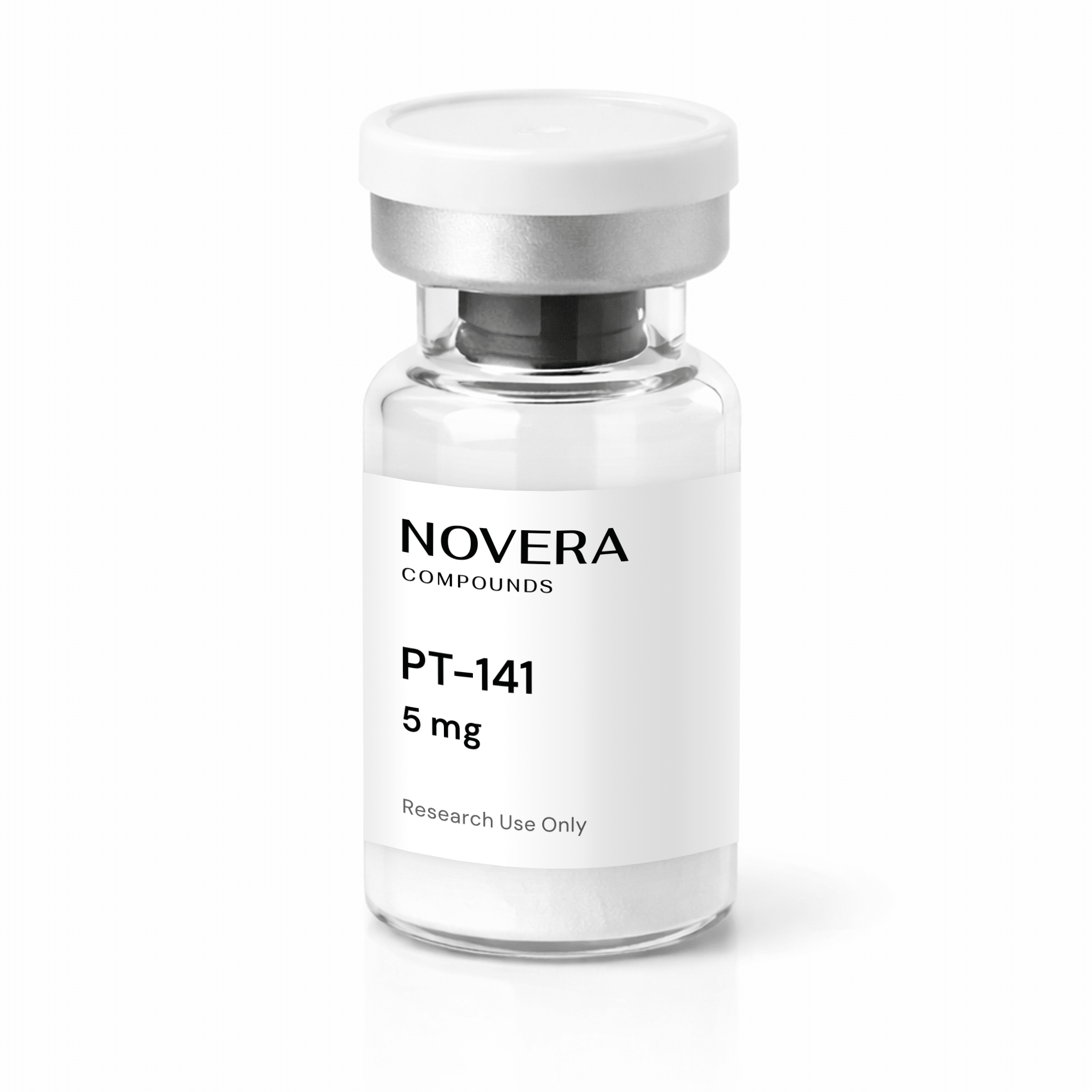
PT-141 (5mg)
Coming Soon
This peptide will be available soon. Join the waitlist to be notified when it launches.
Product description
What is PT-141 (5mg)?
PT-141 (5mg), also known as Bremelanotide, is a synthetic peptide derived from melanocortin hormones. It is part of a group of compounds called melanocortin receptor agonists, which are studied for their role in brain signaling and hormone regulation.- Chemical Formula: C₅₀H₆₈N₁₄O₁₀
- Molecular Weight: 1025.182 g/mol
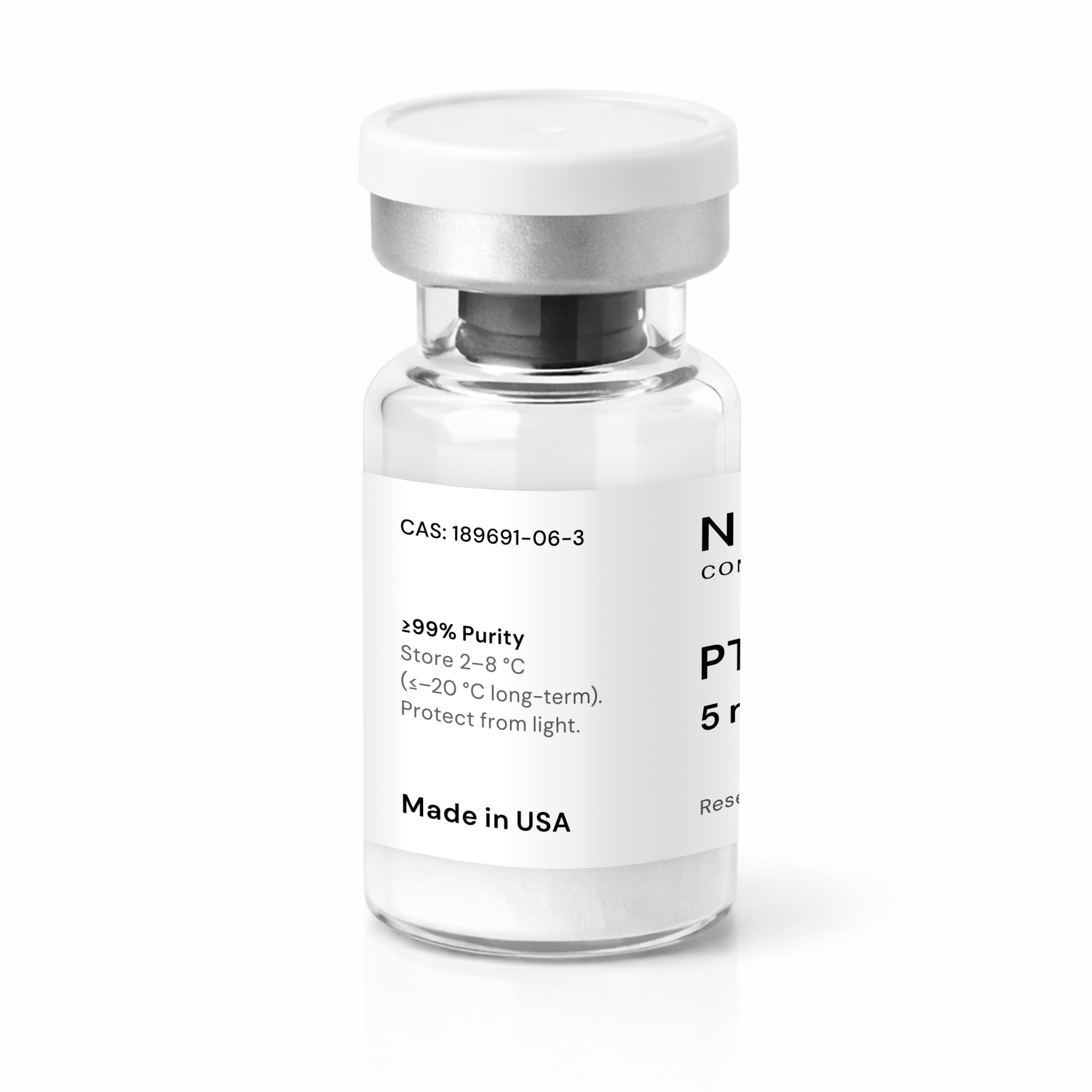
- CAS Number: 189691-06-3
What are the key features of PT-141 (5mg)?
- Supplied as 5 mg lyophilized peptide in a sealed vial
- Verified high purity through laboratory testing
- Studied for its effects on brain and hormone regulation
- Shelf life of approximately 24 months under proper storage conditions
- For laboratory research use only
How is PT-141 (5mg) synthesized?
PT-141 (5mg) is produced using a method called solid-phase peptide synthesis (SPPS), which allows for precise assembly of the peptide’s amino acid chain. This method ensures that the peptide is accurately built from individual amino acids. After synthesis, the peptide is purified using a technique called high-performance liquid chromatography (HPLC) to ensure its purity. Its molecular structure is then confirmed through mass spectrometry (MS). Finally, the purified peptide is lyophilized (dried) to make it stable for storage and transportation.What is PT-141 (5mg) being studied for? What are its possible benefits?
In laboratory studies, PT-141 (5mg) has been investigated for its role in brain signaling and hormone regulation. It is being studied to understand how it affects the body's signaling systems, especially in relation to hormones and brain functions. Research areas involving PT-141 include:- Brain signaling and hormone regulation
- Receptor pathway studies
- Behavioral and neurological studies
- Central nervous system function
How does PT-141 (5mg) work in research studies?
In laboratory studies, PT-141 (5mg) is believed to interact with brain signaling pathways and regulate hormone production. It is thought to work by influencing certain systems in the brain and body that control hormone functions and cell responses. PT-141 is studied as a molecule that can affect brain pathways involved in hormone regulation. Research is looking at how it interacts with brain proteins and cellular mechanisms to understand its full impact. These mechanisms are still under investigation and are examined primarily in lab experiments.What dosing information exists for PT-141 (5mg)?
Research involving PT-141 (5mg) is mainly conducted in laboratory settings, using cell cultures and animal models. In cell culture experiments, PT-141 is often used in concentrations ranging from nanomolar to micromolar to study its effects on cell signaling. Animal studies have tested the peptide at various doses depending on the model and research goals. The exact dosage can vary widely between experiments. There are no human dosing guidelines for PT-141, as it is used solely for research purposes.How should PT-141 (5mg) be stored and handled?
- Store under controlled laboratory conditions to maintain peptide stability. Standard storage is 2–8 °C; for long-term preservation, ≤–20 °C.
- Protect the lyophilized peptide from light, heat, and moisture.
- Room-temperature exposure during transport is acceptable for short durations.
- After reconstitution with sterile solvent, store at 2–8 °C for short-term use.
- Avoid repeated freeze-thaw cycles to preserve peptide integrity.
- When stored correctly, PT-141 remains stable for up to 24 months.
- Follow standard laboratory safety protocols during handling and disposal.
Where can I read more research about PT-141 (5mg)?
- National Center for Biotechnology Information. PubChem Compound Summary for CID 9941379, Bremelanotide. https://pubchem.ncbi.nlm.nih.gov/compound/Bremelanotide
- Wikberg JE, Mutulis F. Targeting melanocortin receptors: an approach to treat weight disorders and sexual dysfunction. Nat Rev Drug Discov. 2008;7(4):307-323. doi:10.1038/nrd2331
- Breit A, Büch TR, Boekhoff I, Solinski HJ, Damm E, Gudermann T. Alternative G protein coupling and biased agonism: new insights into melanocortin-4 receptor signalling. Mol Cell Endocrinol. 2011;331(2):232-240. doi:10.1016/j.mce.2010.07.007
- Mountjoy KG. Functions for pro-opiomelanocortin-derived peptides in obesity and diabetes. Biochem J. 2010;428(3):305-324. Published 2010 May 27. doi:10.1042/BJ20091957
Compliance Statement
This product is intended for laboratory research use only and is not approved for human or veterinary use.Shop with Confidence: Product Authenticity is Guaranteed
All products available at Doctor Medica shop are obtained from respective manufacturers and contain original LOT numbers Contact us if you have any questions about product LOT numbers.


