Your Cart is Empty
Start shopping

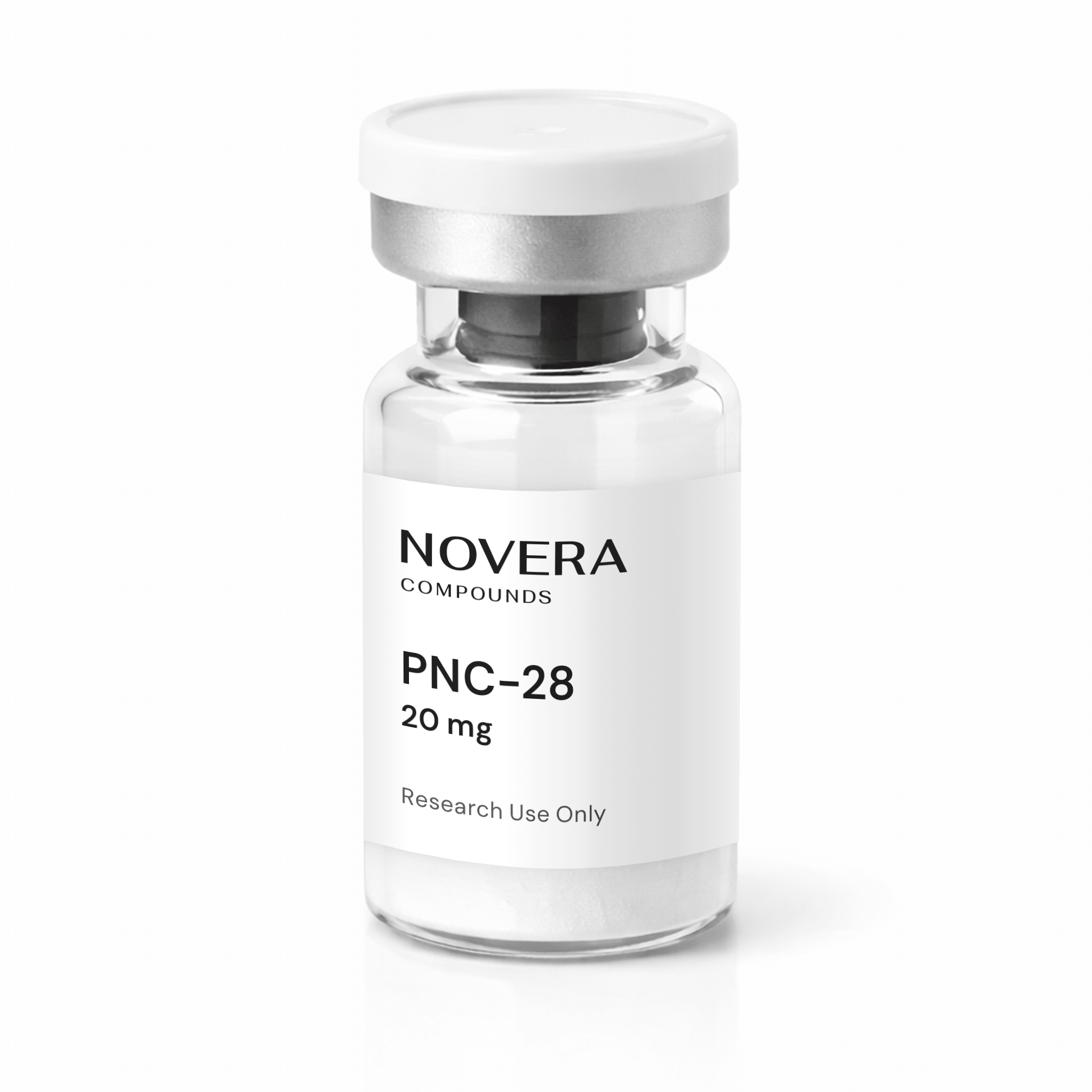
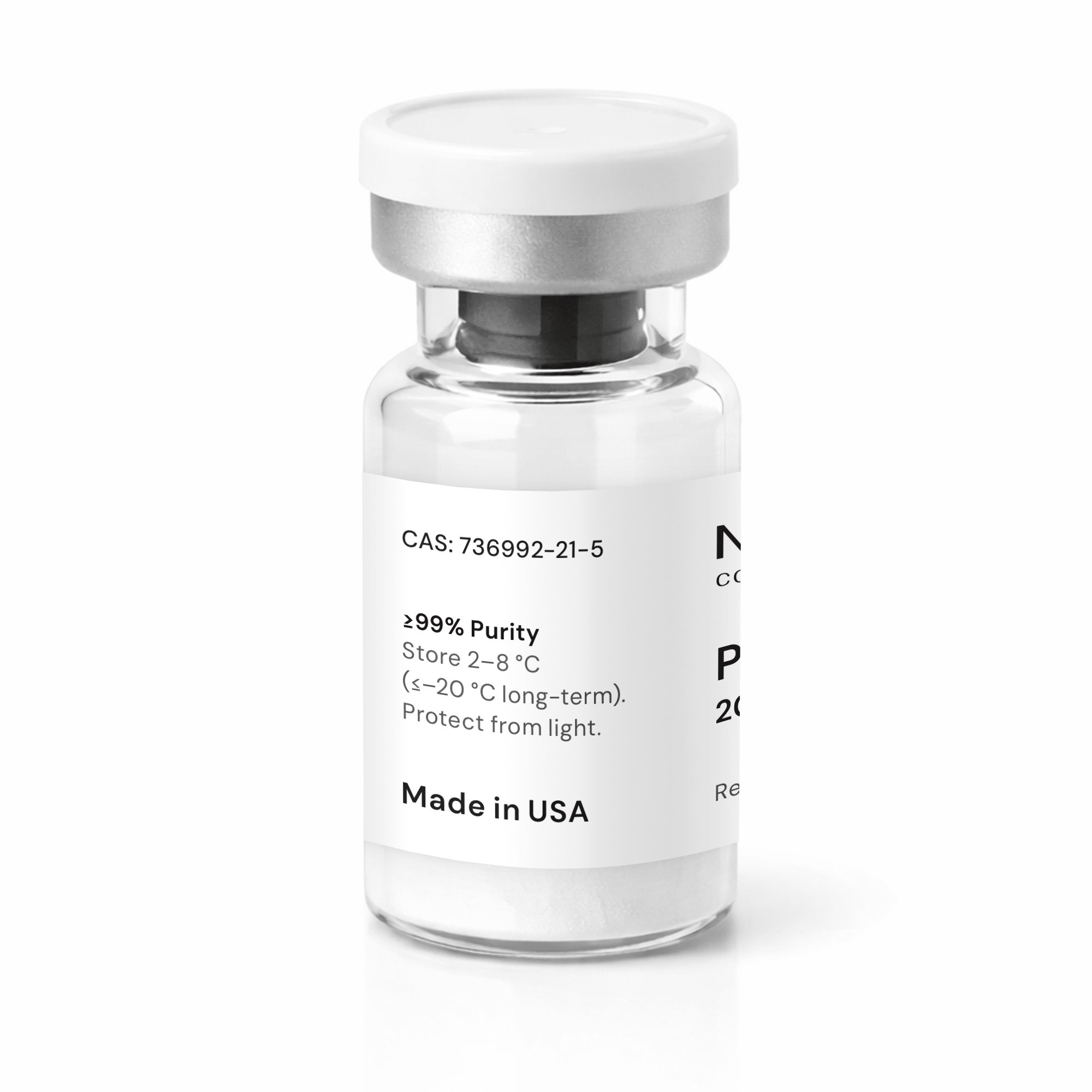
PNC-28 (20mg)
Tier
| Packs | Discount (%) | For Each |
|---|---|---|
| 1 - 5 | — | $185.00 |
| 6 - 10 | 9.73 % | $167.00 |
| 11 - 20 | 18.92 % | $150.00 |
| 21+ | 27.03 % | $135.00 |
Product description
What is PNC-28 (20mg)?
PNC-28 (20mg) is a synthetic peptide derived from the p53 tumor suppressor protein, specifically incorporating a segment corresponding to residues 17–26 of p53, linked to a cell-penetrating sequence. This design enables the peptide to enter cells in laboratory models, making it useful for research investigating tumor biology and membrane-associated signaling pathways. Identification:- Chemical Formula: C₁₆₄H₂₅₅N₄₇O₃₇S
- Molecular Weight: 3509.13 g/mol
- CAS Number: 392661-17-5
- Sequence: Glu-Thr-Phe-Ser-Asp-Leu-Trp-Lys-Leu-Leu-Lys-Lys-Trp-Lys-Met-Arg-Arg-Asn-Gln-Phe-Trp-Val-Lys-Val-Gln-Arg-Gly
What are the key features of PNC-28 (20mg)?
- Supplied as 20 mg lyophilized peptide in a sealed research vial
- High analytical purity verified through laboratory testing
- Studied in tumor cell biology and membrane interaction research
- Approximate 24-month shelf life when stored under recommended conditions
- For laboratory research use only
How is PNC-28 (20mg) synthesized?
PNC-28 (20mg) is typically manufactured using solid-phase peptide synthesis (SPPS), a technique commonly used to assemble peptides with precise amino acid sequences. During this process, the peptide chain is built step-by-step using protected amino acid derivatives to replicate the p53-derived peptide segment combined with the penetratin sequence. Following synthesis, purification is performed by high-performance liquid chromatography (HPLC) to ensure high purity. Analytical verification of molecular weight and structural integrity is conducted using mass spectrometry (MS). The final peptide is lyophilized to improve stability, making it suitable for storage and transport for laboratory use.What is PNC-28 (20mg) being studied for? What are its possible benefits?
In experimental research, PNC-28 (20mg) has been studied in models related to tumor biology and cellular membrane signaling. Because the peptide contains a p53-derived sequence, it is investigated for its potential ability to interact with proteins associated with cell survival and tumor development. Research areas involving PNC-28 include:- Cancer cell biology research
- Tumor membrane protein interactions
- Necrosis and cell death signaling studies
- Cell proliferation and growth regulation models
- Experimental oncology investigations
How does PNC-28 (20mg) work in research studies?
In laboratory settings, PNC-28 (20mg) is believed to function by interacting with membrane proteins found on certain tumor cells. The peptide incorporates a cell-penetrating sequence, allowing it to enter cells or associate with cellular membranes in experimental models. Research suggests that the p53-derived region of the peptide may bind to proteins associated with tumor cell survival. However, studies have shown that the primary observed effect of PNC-28 is the induction of necrosis in tumor cells, rather than apoptosis. This necrotic effect is specifically driven by the penetratin sequence, which facilitates peptide uptake into cells and membrane interaction. These mechanisms remain under investigation and are primarily studied in cell culture and animal models.What dosing information exists for PNC-28 (20mg)?
Research on PNC-28 (20mg) has primarily been conducted in preclinical studies using cell cultures and animal models. In vitro experiments often evaluate peptide concentrations in the nanomolar to micromolar range to study cellular responses. Animal studies have reported experimental dosing ranges in microgram per kilogram (µg/kg) levels depending on the specific tumor model and research objective. Because PNC-28 is an investigational peptide used in laboratory studies, there are no established human dosing guidelines, and its use is restricted to research environments.How should PNC-28 (20mg) be stored and handled?
- Store under temperature-controlled conditions per laboratory protocol and certificate of analysis
- Protect the lyophilized peptide from light, heat, and moisture
- Room-temperature exposure during transport is acceptable for short durations
- Once reconstituted, store the solution under appropriate temperature-controlled conditions per laboratory protocol
- Avoid repeated freeze-thaw cycles to maintain peptide integrity
- Follow standard laboratory safety protocols during handling and disposal
Where can I read more research about PNC-28 (20mg)?
Researchers interested in the p53-derived peptide PNC-28 and related tumor biology studies may consult the following scientific publications:- Bowne WB, Sookraj KA, Vishnevetsky M, et al. The penetratin sequence in the anticancer PNC-28 peptide causes tumor cell necrosis rather than apoptosis of human pancreatic cancer cells. Ann Surg Oncol. 2008;15(12):3588-3600. doi:10.1245/s10434-008-0147-0
- Michl J, Scharf B, Schmidt A, et al. PNC-28, a p53-derived peptide that is cytotoxic to cancer cells, blocks pancreatic cancer cell growth in vivo. Int J Cancer. 2006;119(7):1577-1585. doi:10.1002/ijc.22029
- Pincus MR, Silberstein M, Zohar N, Sarafraz-Yazdi E, Bowne WB. Poptosis or Peptide-Induced Transmembrane Pore Formation: A Novel Way to Kill Cancer Cells without Affecting Normal Cells. Biomedicines. 2024;12(6):1144. Published 2024 May 22. doi:10.3390/biomedicines12061144
- National Center for Biotechnology Information. PubChem Compound Summary for CID 16158363, Pnc-28. https://pubchem.ncbi.nlm.nih.gov/compound/Pnc-28.
Compliance Notice
This product is intended for laboratory research use only and is not approved for human or veterinary use.Shop with Confidence: Product Authenticity is Guaranteed
All products available at Doctor Medica shop are obtained from respective manufacturers and contain original LOT numbers Contact us if you have any questions about product LOT numbers.


