Your Cart is Empty
Start shopping

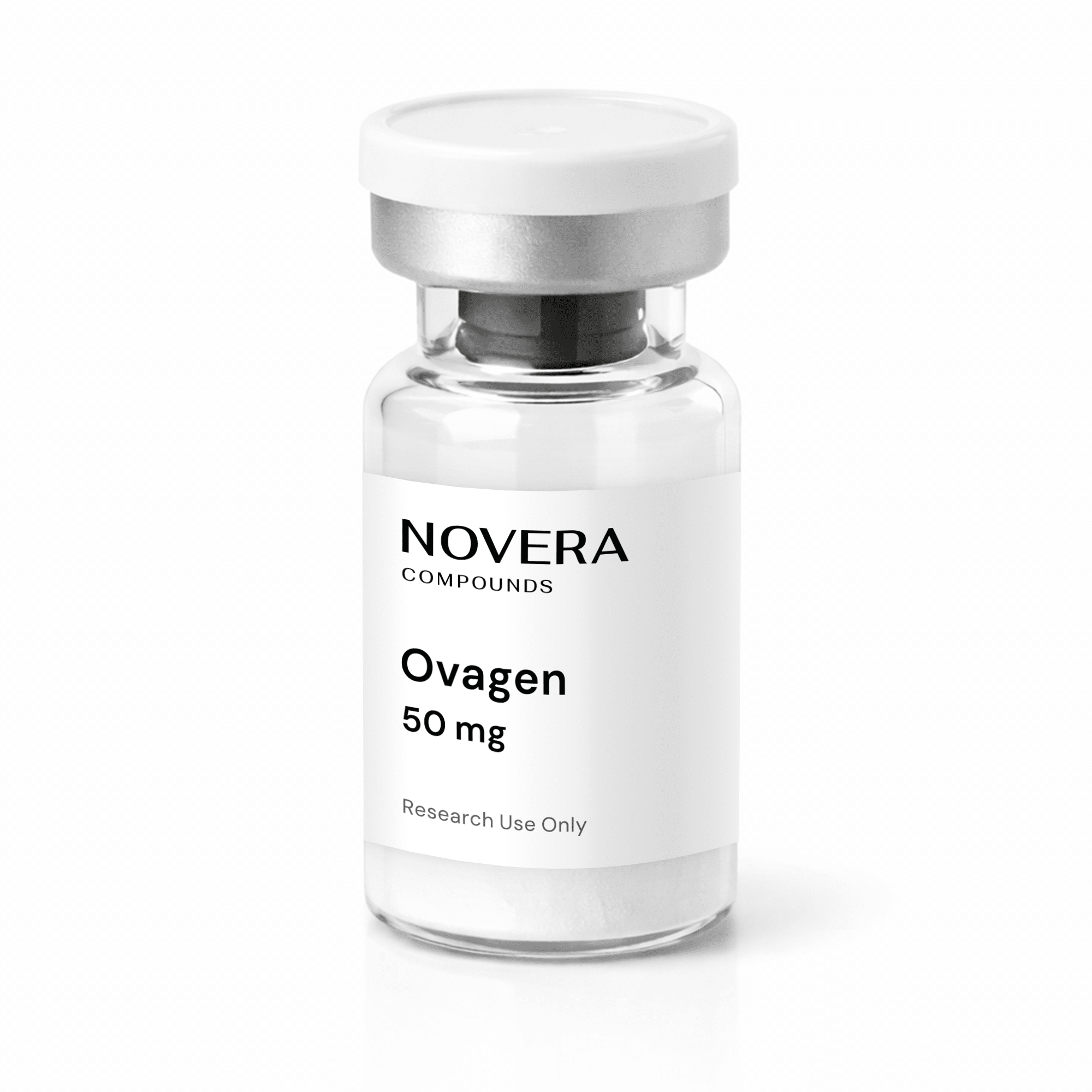
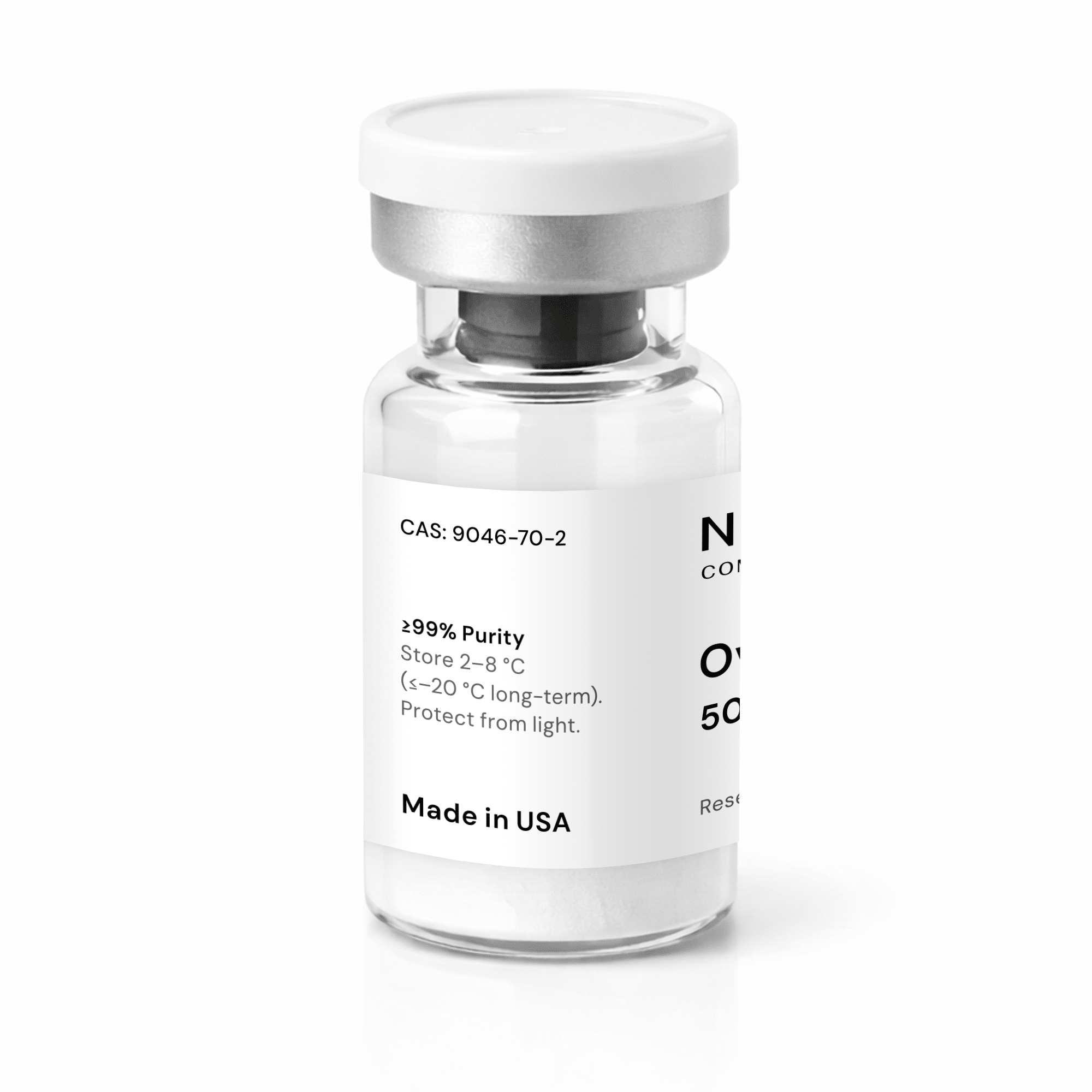
Ovagen (50mg)
Coming Soon
This peptide will be available soon. Join the waitlist to be notified when it launches.
Product description
What is Ovagen (50mg)?
Ovagen (50mg) is a synthetic tripeptide supplied as a lyophilized powder for experimental use in biochemical and cellular studies. It belongs to a category of organ-specific and bioregulator peptides, which are short regulatory molecules investigated for their ability to influence cellular signaling and gene expression in specific tissues. Researchers have examined Ovagen in liver and gastrointestinal cell models to better understand peptide-based regulatory mechanisms. The peptide contains three amino acids and has a molecular weight of 375.37 g/mol. Key chemical identifiers include:- Chemical Formula: C₁₅H₂₅N₃O₈
- Peptide Sequence: Glu–Asp–Leu
- Synonym: Ovagen Bioregulator
What are the key features of Ovagen (50mg)?
Ovagen (50mg) is supplied as a high-purity peptide preparation designed for controlled laboratory experiments. The lyophilized powder format allows researchers to prepare specific concentrations based on the needs of their biochemical assays or cell culture models. Key features include:- Synthetic tripeptide composed of Glu–Asp–Leu
- Supplied in a 50 mg lyophilized vial for flexible research use
- Typically manufactured with high analytical purity, verified by chromatographic testing
- Investigated in laboratory studies involving hepatic and gastrointestinal cellular systems
- Suitable for biochemical assays studying gene-expression signaling and cellular regulation
- Characterized using analytical methods such as HPLC and mass spectrometry
- For laboratory research use only
How is Ovagen (50mg) synthesized?
Ovagen is synthesized using solid-phase peptide synthesis (SPPS), a widely used method for assembling short peptides with high accuracy. During this process, individual amino acids are sequentially linked to form the tripeptide structure Glu–Asp–Leu. The resulting peptide is purified and isolated as a stable lyophilized powder suitable for research applications. Quality verification typically involves analytical techniques such as high-performance liquid chromatography (HPLC) to assess purity and mass spectrometry (MS) to confirm the correct molecular weight and peptide identity. These verification methods ensure that the final product meets laboratory standards for biochemical assays, gene-expression experiments, and cellular research models.What is Ovagen (50mg) being studied for? What are its possible benefits?
Ovagen has been studied in experimental systems to explore how short regulatory peptides may influence cellular signaling and tissue-specific gene expression. In hepatic research models, investigators have examined how the peptide interacts with regulatory pathways related to cellular growth, extracellular matrix organization, and transcriptional control. Additionally, Ovagen has been investigated in gastrointestinal models for its potential effects on epithelial cell activity and mucosal signaling pathways. Some laboratory investigations have also explored the interactions between small peptides and enzyme systems, including viral proteases. Ovagen was initially named in reference to ovarian tissue research; however, most published laboratory investigations have focused on hepatic and gastrointestinal cellular models. These observations remain limited to controlled preclinical experiments and are aimed at understanding peptide-based regulatory mechanisms.How does Ovagen (50mg) work in research studies?
In laboratory studies, Ovagen is believed to function as a regulatory signaling peptide that interacts with intracellular systems that influence gene expression. Small peptides like Ovagen have been investigated for their ability to enter cells and interact with chromatin-associated proteins or transcription factors involved in cellular regulation. Researchers study Ovagen by introducing it into cell cultures or biochemical assays and observing changes in molecular markers such as transcription activity, extracellular matrix proteins, or signaling molecules. These experimental approaches help scientists examine how short peptides may influence cellular communication and gene-regulation processes in controlled laboratory environments.What dosing information exists for Ovagen (50mg)?
Experimental dosing information for peptides like Ovagen is primarily based on preclinical or in-vitro research models. In laboratory studies involving peptide bioregulators, concentrations typically fall within the micromolar range for biochemical assays evaluating enzyme activity or gene expression responses. Some animal-model research exploring regulatory peptides has reported dosing ranges of 2–8 µg/kg, administered in controlled experimental settings. In vitro studies may use concentrations between 0.1 µg/mL and 1.5 µg/mL, depending on the assay design. These parameters are specific to experimental models and should not be interpreted as dosing recommendations. There are no established human dosing guidelines for Ovagen (50mg).How should Ovagen (50mg) be stored and handled?
- Store lyophilized Ovagen at ≤–20 °C. Protect from light and moisture.
- After reconstitution, store solutions at 2–8 °C and minimize freeze–thaw cycles by preparing single-use aliquots.
- Document preparation conditions to support experimental reproducibility.
- For laboratory research use only.
Where can I read more research about Ovagen (50mg)?
Researchers interested in peptide bioregulators and short regulatory peptides may consult the following scientific publications:- Anisimov VN, Khavinson VKh. Peptide bioregulation of aging: results and prospects. Biogerontology. 2009;11(2):139-149. doi:10.1007/s10522-009-9249-8
- Khavinson VKh, Bondarev IE, Butyugov AA. Epithalon peptide induces telomerase activity and telomere elongation in human somatic cells. Bull Exp Biol Med. 2003;135(6):590-592. doi: 10.1023/a:1025493705728. PMID: 12937682.
- Louis JM, Dyda F, Nashed NT, Kimmel AR, Davies DR. Hydrophilic peptides derived from the transframe region of Gag-Pol inhibit the HIV-1 protease. Biochemistry. 1998;37(8):2105-2110. doi:10.1021/bi972059x
- Khavinson VKh. Peptides and Ageing. Neuro Endocrinol Lett. 2002;23 Suppl 3:11-144.
Compliance Statement
This product is intended for laboratory research use only and is not approved for human or veterinary use.Shop with Confidence: Product Authenticity is Guaranteed
All products available at Doctor Medica shop are obtained from respective manufacturers and contain original LOT numbers Contact us if you have any questions about product LOT numbers.


