Your Cart is Empty
Start shopping

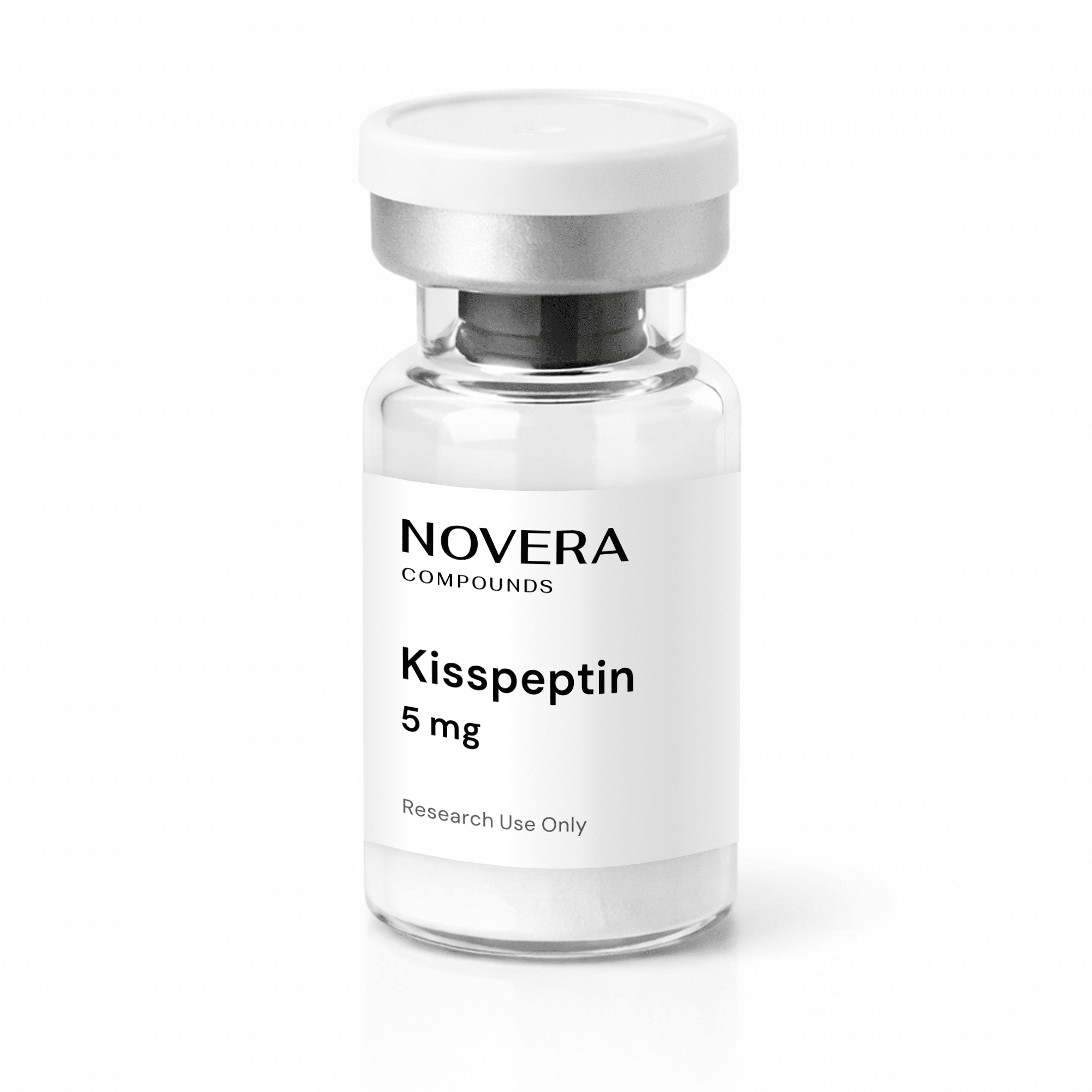
Kisspeptin (5mg)
Coming Soon
This peptide will be available soon. Join the waitlist to be notified when it launches.
Product description
What is Kisspeptin (5mg)?
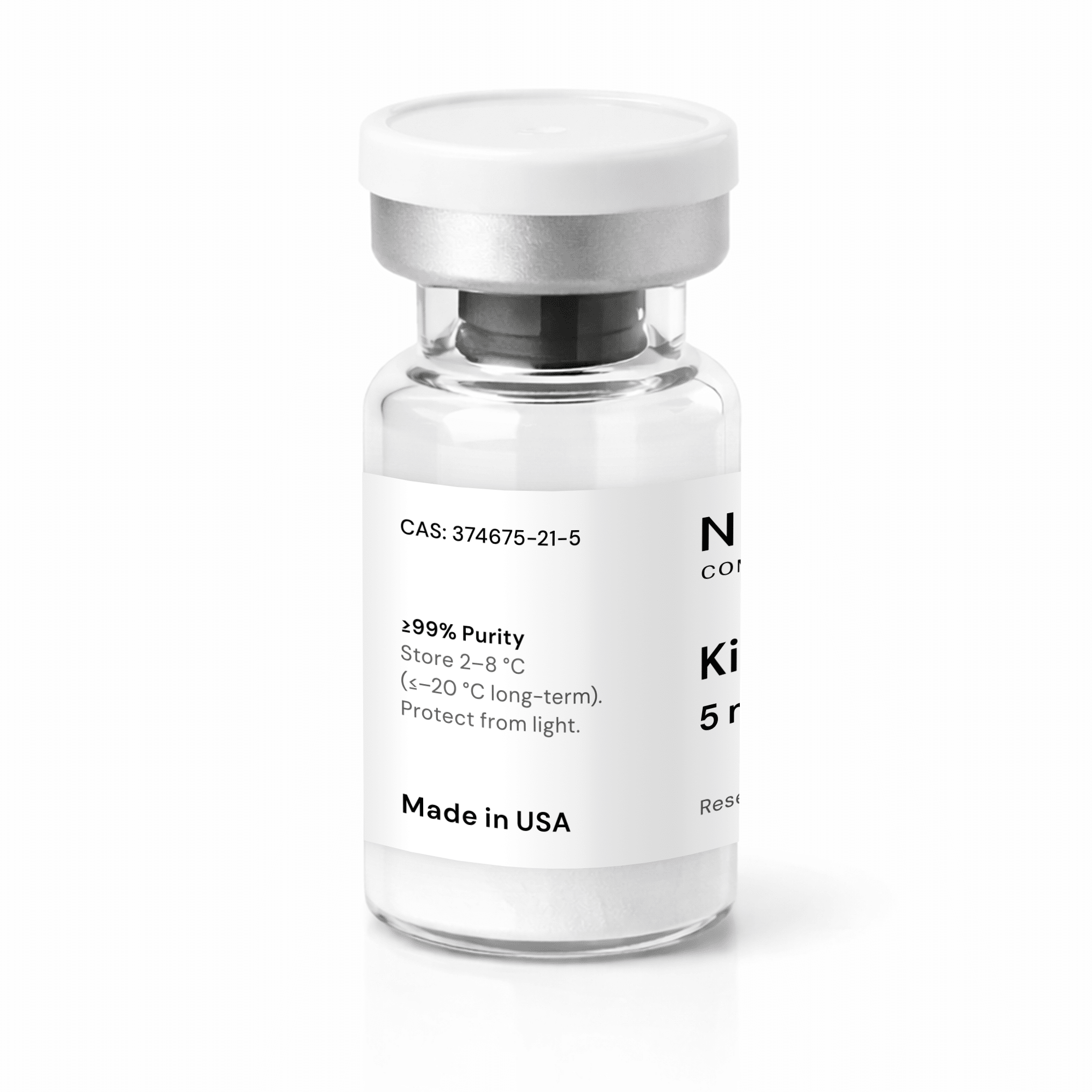
Kisspeptin (5mg) is a synthetic decapeptide derived from the C-terminal region of the KISS1 protein. It is widely used in neuroendocrine research to study hormonal signaling pathways involved in reproductive biology. In peptide catalogs, it is commonly classified among sexual health and hormonal peptides due to its role in regulating endocrine communication in experimental models. Kisspeptin, also known as Metastin (45–54) and KP-10, consists of ten amino acids and has a molecular weight of 1302.4 g/mol. Key identifiers include:- CAS Number: 374675-21-5
- Chemical Formula: C₆₃H₈₃N₁₇O₁₄
- Peptide Sequence: Tyr-Asn-Trp-Asn-Ser-Phe-Gly-Leu-Arg-Phe-NH₂
What are the key features of Kisspeptin (5mg)?
Kisspeptin (5mg) is typically supplied as a lyophilized peptide powder in a sterile vial. This format ensures stable storage and convenient reconstitution for laboratory research. High-purity batches are commonly validated through analytical testing to support reproducible results in biochemical and cellular studies. Key features include:- Synthetic decapeptide fragment derived from the endogenous KISS1 protein
- Supplied as a 5 mg lyophilized peptide for laboratory reconstitution
- Typically manufactured with ≥99% purity, verified by analytical testing
- Quality confirmation using HPLC and mass spectrometry
- Frequently used in research involving reproductive endocrinology and neuroendocrine signaling
- For laboratory research use only
How is Kisspeptin (5mg) synthesized?
Kisspeptin (5mg) is produced by solid-phase peptide synthesis (SPPS), a standard technique for synthesizing short peptide sequences with precise amino acid sequences. This method allows researchers to replicate the natural C-terminal sequence of the KISS1 protein while maintaining high structural accuracy. After synthesis, the peptide undergoes purification to remove residual reagents and incomplete sequences. Analytical verification typically includes high-performance liquid chromatography (HPLC) to confirm purity and mass spectrometry (MS) to verify molecular weight and structural integrity. These quality control procedures ensure that the peptide meets research standards for laboratory experiments.What is Kisspeptin (5mg) being studied for? What are its possible benefits?
Kisspeptin has been widely studied for its role in regulating communication between the hypothalamus and the pituitary gland in experimental endocrine models. Research has focused on how the peptide influences signaling pathways involved in gonadotropin-releasing hormone (GnRH) production and subsequent hormone secretion patterns. Additional research areas include:- Reproductive hormone signaling pathways
- Puberty-related neuroendocrine mechanisms
- Energy balance and metabolic signaling interactions
- Cellular processes involved in tumor migration and metastasis
How does Kisspeptin (5mg) work in research studies?
In laboratory studies, Kisspeptin is used to explore signaling pathways involved in neuroendocrine communication. When applied in experimental models, the peptide influences cellular activity related to hormone regulation and gene expression within endocrine tissues. Researchers commonly use Kisspeptin to study how neuroendocrine signals initiate hormonal cascades within the hypothalamic-pituitary-gonadal axis. Through these systems, scientists can investigate how peptide-based signaling molecules regulate endocrine rhythms, reproductive hormone release, and other cellular responses linked to hormonal control.What dosing information exists for Kisspeptin (5mg)?
Dosing information for Kisspeptin is derived from preclinical and experimental research models. In rodent studies, intravenous doses ranging from 0.3 to 30 nmol/kg have been used to evaluate hormonal signaling responses. Lower doses, such as 0.3 nmol/kg, have been observed to elicit measurable endocrine responses under certain experimental conditions. Other animal studies have explored microgram-level doses to investigate developmental and reproductive effects. In in vitro studies, concentrations between 100 nM and 10 µM have been used to examine cellular responses within hypothalamic and pituitary cell models. These dosing levels are specific to controlled research environments. No established human dosing guidelines exist for Kisspeptin research peptides.How should Kisspeptin (5mg) be stored and handled?
- Store lyophilized Kisspeptin-10 at ≤–20 °C. Protect from light and moisture.
- After reconstitution, store solutions at 2–8 °C and minimize freeze–thaw cycles by preparing single-use aliquots.
- Document preparation conditions to support experimental reproducibility.
- For laboratory research use only.
Where can I read more research about Kisspeptin (5mg)?
The following peer-reviewed publications provide background on Kisspeptin research and its biological roles in experimental studies.- Tovar S, Vázquez MJ, Navarro VM, et al. Effects of Single or Repeated Intravenous Administration of Kisspeptin upon Dynamic LH Secretion in Conscious Male Rats. Endocrinology. 2006;147(6):2696-2704. doi:10.1210/en.2005-1397
- Ramzan F, Qureshi IZ. Intraperitoneal kisspeptin-10 administration induces dose-dependent degenerative changes in maturing rat testes. Life Sciences. 2010;88(5-6):246-256. doi:10.1016/j.lfs.2010.11.019
- Orlando G, Leone S, Ferrante C, et al. Effects of kisspeptin-10 on hypothalamic neuropeptides and neurotransmitters involved in appetite control. Molecules. 2018;23(12):3071. doi:10.3390/molecules23123071
- Suzuki S, Kadokawa H, Hashizume T. Direct kisspeptin-10 stimulation on luteinizing hormone secretion from bovine and porcine anterior pituitary cells. Animal Reproduction Science. 2007;103(3-4):360-365. doi:10.1016/j.anireprosci.2007.05.016
Compliance Statement
This product is intended for laboratory research use only and is not approved for human or veterinary use.Shop with Confidence: Product Authenticity is Guaranteed
All products available at Doctor Medica shop are obtained from respective manufacturers and contain original LOT numbers Contact us if you have any questions about product LOT numbers.


