Your Cart is Empty
Start shopping

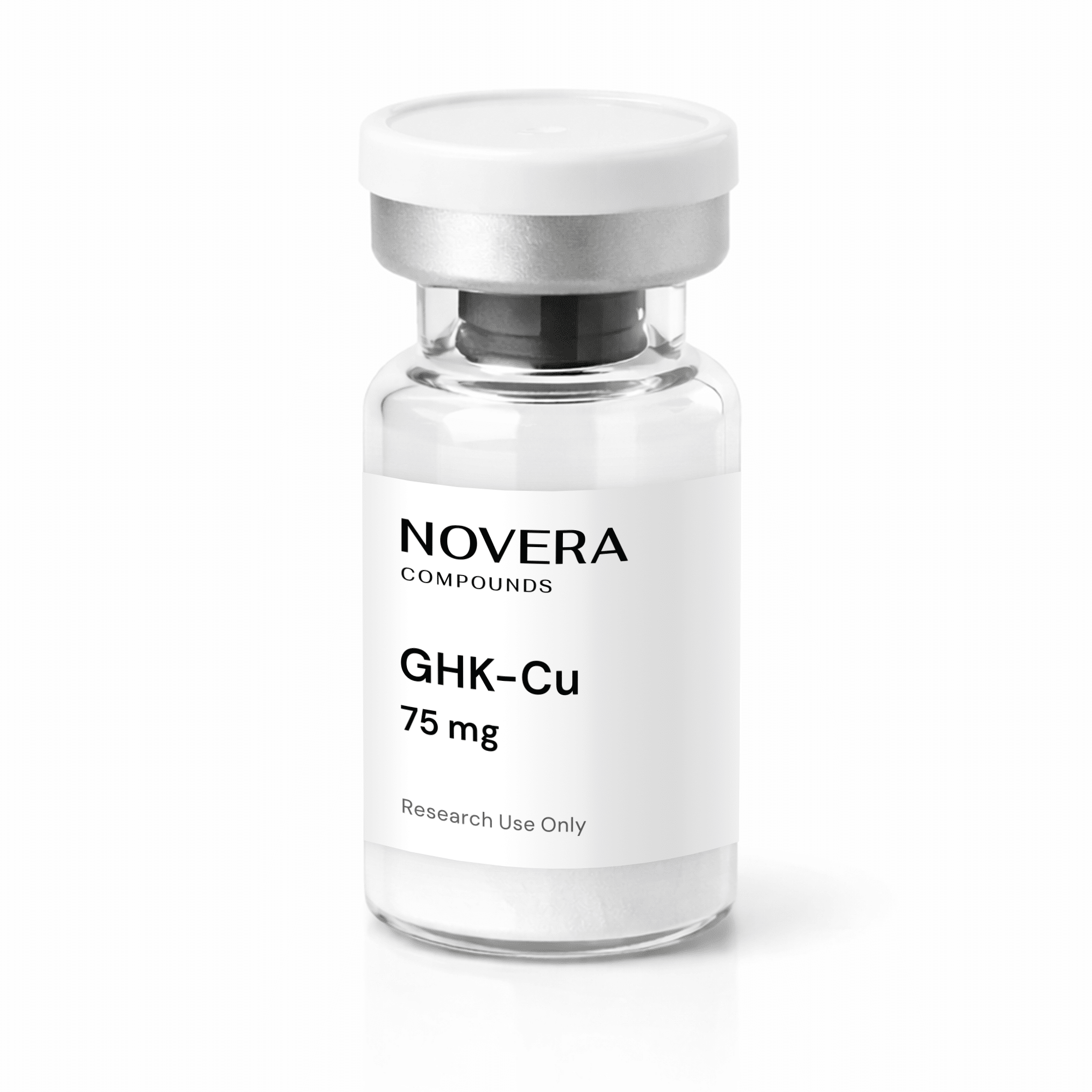
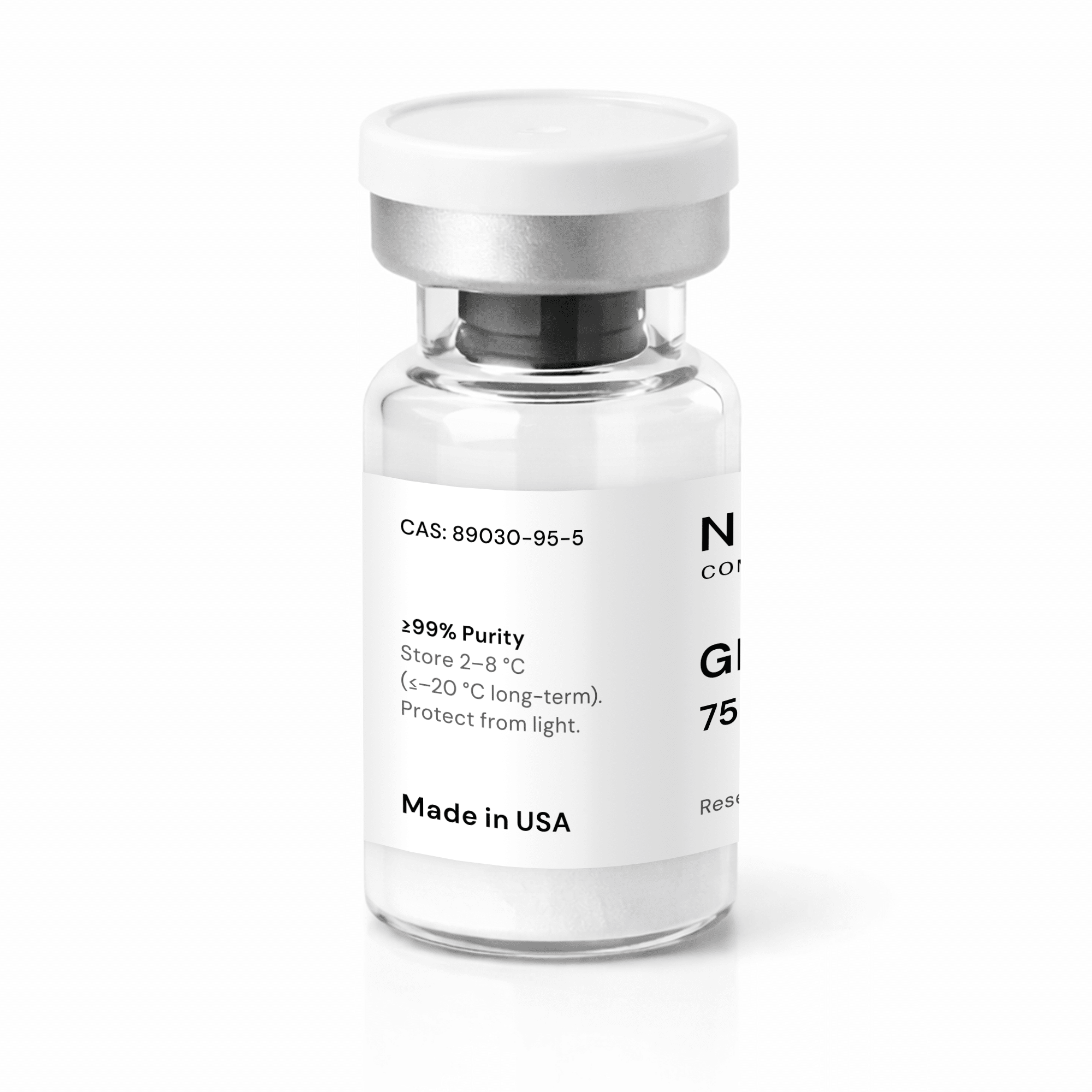
GHK-CU (75 mg)
Coming Soon
This peptide will be available soon. Join the waitlist to be notified when it launches.
Product description
What is GHK-Cu (75mg)?
GHK-Cu (75mg) is a copper-binding tripeptide made up of three amino acids—Glycine, Histidine, and Lysine—combined with a copper (Cu²⁺) ion. It is often called a copper peptide and is classified as a bioactive metal–peptide complex. The peptide sequence is Gly-His-Lys(Cu²⁺), forming a stable structure with copper.- Chemical Formula: C₁₄H₂₁N₆O₄Cu
- Molecular Weight: 401.91 g/mol
- CAS Number: 89030-95-5
What are the key features of GHK-Cu (75mg)?
GHK-Cu (75mg) is provided as a research-grade copper–peptide complex for controlled experimental use.- ≥95% purity (analytically verified)
- Supplied as 75 mg lyophilized peptide complex in a sealed vial
- Tripeptide sequence with copper (Cu²⁺) coordination
- Studied in tissue repair and extracellular matrix research
- Stable for approximately 24 months when stored properly
- For laboratory research use only
- Intended strictly for in vitro and preclinical investigations
How is GHK-Cu (75mg) synthesized?
GHK-Cu (75mg) is produced using solid-phase peptide synthesis (SPPS) to build the Gly-His-Lys tripeptide backbone. After the peptide is made, copper ions are carefully added to create the copper peptide complex. The resulting compound is purified using high-performance liquid chromatography (HPLC) to ensure high purity. The molecular identity and weight are confirmed with mass spectrometry (MS). The final product is lyophilized to improve stability for storage and transport.What is GHK-Cu (75mg) being studied for? What are its possible benefits?
GHK-Cu (75mg) has been studied in research related to tissue repair and cellular processes. Investigations have focused on:- Regulation of the extracellular matrix
- Collagen and elastin studies
- Wound healing research
- Skin biology
- Hair follicle studies
How does GHK-Cu (75mg) work in research studies?
In research, GHK-Cu (75mg) is studied for its ability to bind copper and influence cellular pathways. Copper is an essential element in many enzyme processes, and the peptide complex may help control copper availability in experimental systems. Experts believe that GHK-Cu may influence gene expression and protein production that are important for tissue structure. It has been linked to the regulation of growth factor activity and inflammation in research models. These processes remain investigational.What dosing information exists for GHK-Cu (75mg)?
Studies involving GHK-Cu have mostly been conducted in cell cultures and animal models. In laboratory tests, concentrations are often in the nanomolar to micromolar range to assess their effects on fibroblast activity and collagen production. In animal studies, dosing is typically expressed as micrograms per kilogram (µg/kg), depending on the experimental design and the method of administration. Dosing schedules vary across studies. There are no established human dosing guidelines for GHK-Cu (75mg), as it is intended exclusively for laboratory research.How should GHK-Cu (75mg) be stored and handled?
GHK-Cu (75mg) should be stored at 2–8 °C for regular laboratory handling. For long-term storage, keep it at ≤–20 °C. Protect the product from excessive light and moisture. After reconstitution with a sterile laboratory-grade solvent, short-term storage at 2–8 °C is advised. Avoid repeated freeze-thaw cycles to maintain stability. The product has a shelf life of approximately 24 months when stored under recommended conditions. Standard laboratory protective equipment should be used during handling, and disposal should follow institutional biosafety guidelines.Where can I read more research about GHK-Cu (75mg)?
The following peer-reviewed publications provide background information on GHK-Cu research:- Pickart L, Vasquez-Soltero JM, Margolina A. GHK Peptide as a Natural Modulator of Multiple Cellular Pathways in Skin Regeneration. Biomed Res Int. 2015;2015:648108. doi:10.1155/2015/648108
- Pickart L, Margolina A. Regenerative and Protective Actions of the GHK-Cu Peptide in the Light of the New Gene Data. Int J Mol Sci. 2018;19(7):1987. Published 2018 Jul 7. doi:10.3390/ijms19071987
- Pickart L. The human tri-peptide GHK and tissue remodeling. J Biomater Sci Polym Ed. 2008;19(8):969-988. doi:10.1163/156856208784909435
- Pickart L, Vasquez-Soltero JM, Margolina A. The Effect of the Human Peptide GHK on Gene Expression Relevant to Nervous System Function and Cognitive Decline. Brain Sci. 2017;7(2):20. Published 2017 Feb 15. doi:10.3390/brainsci7020020
- National Center for Biotechnology Information. PubChem Compound Summary for CID 139035031, Copper tripeptide. https://pubchem.ncbi.nlm.nih.gov/compound/Copper-tripeptide.
Compliance Statement
This product is intended for laboratory research use only and is not approved for human or veterinary use.Shop with Confidence: Product Authenticity is Guaranteed
All products available at Doctor Medica shop are obtained from respective manufacturers and contain original LOT numbers Contact us if you have any questions about product LOT numbers.


