Your Cart is Empty
Start shopping

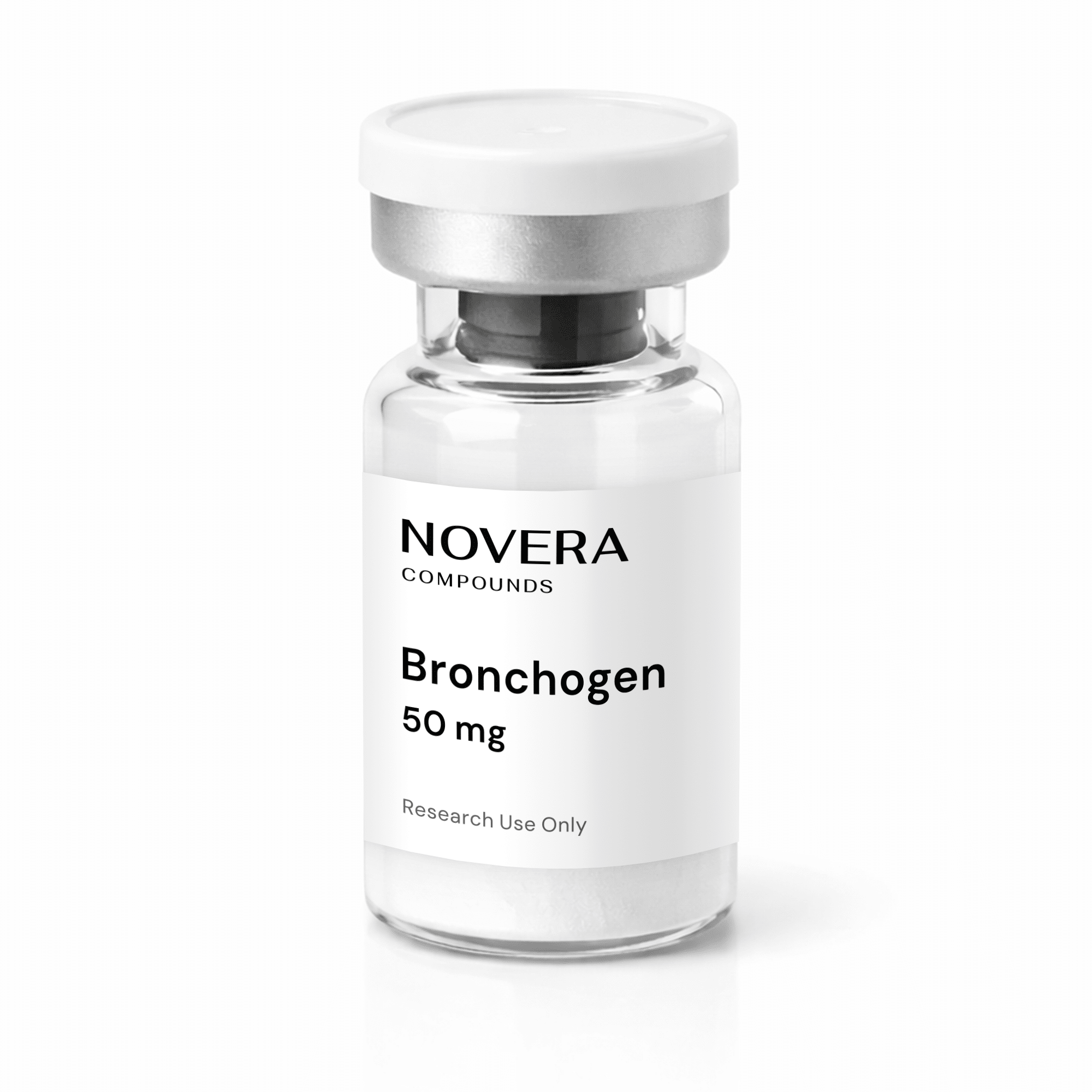
Bronchogen (50mg)
Coming Soon
This peptide will be available soon. Join the waitlist to be notified when it launches.
Product description
What is Bronchogen (50mg)?
Bronchogen is a short synthetic tetrapeptide, often referred to as AEDL (Ala-Asp-Glu-Leu) in the literature. It has been studied in laboratory research for its interactions with bronchial epithelial cells and its potential role in gene-expression-related cellular processes. In research, Bronchogen is discussed as a low-molecular-weight peptide rather than a clinically established treatment.- Chemical Formula: C₁₈H₃₀N₄O₉
- Molecular Weight: 446.45 g/mol
- Sequence: Ala-Glu-Asp-Leu (AEDL)
What are the key features of Bronchogen (50mg)?
Bronchogen (50mg) is typically presented in research catalogs as a lyophilized peptide intended for controlled laboratory use. The research focuses on bronchial epithelial models, DNA interaction studies, and organotypic tissue culture observations rather than validated therapeutic applications.- Peptide type: Tetrapeptide (4 amino acids, identified as ADEL in published studies)
- Subcategory: Organ-Specific & Bioregulator Peptides
- Research focus: Studied in bronchial epithelium and lung-related models
- Analytical identity: Verified by HPLC and mass spectrometry (MS) in vendor QC/COA
- Format: Supplied as 50 mg in a lyophilized vial (exact presentation may vary; verify with supplier)
- Purity: Purity should be confirmed from the lot-specific COA, not inferred from journal articles
- Compliance: For laboratory research use only
How is Bronchogen (50mg) synthesized?
Bronchogen (50mg) is synthesized using peptide synthesis methods, which assemble the 4-amino-acid sequence in a controlled, step-by-step process. No metal ions are involved in the synthesis. The resulting peptide is purified by high-performance liquid chromatography (HPLC) to achieve the desired purity. Mass spectrometry (MS) is typically used to confirm the molecular weight and structural integrity. The peptide is then lyophilized to ensure stability during storage and transport.What is Bronchogen (50mg) being studied for? What are its possible benefits?
Bronchogen (50mg) is being researched for its potential role in:- Bronchial epithelium function
- Epithelial differentiation markers
- Tissue remodeling in lung pathology
- Modulation of inflammatory markers in bronchoalveolar lavage fluid
- Structural changes in epithelial tissue after peptide exposure
How does Bronchogen (50mg) work in research studies?
Bronchogen is thought to act by modulating cellular regulatory processes related to gene expression and protein synthesis. A study of the peptide in human bronchial epithelial cultures showed changes in gene expression related to epithelial differentiation and functional maintenance, including changes in protein markers such as Ki67 and Mcl-1. Other studies have reported evidence of Bronchogen’s interaction with DNA using techniques such as spectrophotometry, viscometry, and circular dichroism. These studies suggest that the peptide binds to DNA in major-groove regions, though these findings are based on laboratory models and do not prove clinical efficacy.What dosing information exists for Bronchogen (50mg)?
Published dosing information is limited and varies across studies. One organotypic tissue culture study using Bronchogen reported an effective concentration of 0.05 ng/mL in tissue cultures from young and aged rats. Other publications describe the duration of peptide treatment (e.g., 1 month in a rat obstructive lung model) but do not always specify the exact dose. Some studies report molar ratios of Bronchogen to DNA base pairs rather than mg/kg dosing. There are no established human dosing guidelines for Bronchogen (50mg), and the vial size should not be considered as a dosing recommendation.How should Bronchogen (50mg) be stored and handled?
Bronchogen (50mg) should be stored according to the supplier’s instructions. Generally, lyophilized peptides are stored at –20 °C, protected from light and moisture, and shielded from temperature fluctuations to preserve peptide integrity. Once reconstituted for laboratory use, Bronchogen should be stored at 2–8 °C. It is important to label the vial properly, minimize storage time, and follow sterile handling protocols. Shelf life and stability can vary based on formulation and packaging, so researchers should consult the supplier’s COA for specific storage guidelines.Where can I read more research about Bronchogen (50mg)?
- Kuzubova NA, Lebedeva ES, Dvorakovskaya IV, Surkova EA, Platonova IS, Titova ON. Modulating Effect of Peptide Therapy on the Morphofunctional State of Bronchial Epithelium in Rats with Obstructive Lung Pathology. Bull Exp Biol Med. 2015;159(5):685-688. doi:10.1007/s10517-015-3047-x
- Monaselidze JR, Khavinson VKh, Gorgoshidze MZ, et al. Effect of the peptide bronchogen (Ala-Asp-Glu-Leu) on DNA thermostability. Bull Exp Biol Med. 2011;150(3):375-377. doi:10.1007/s10517-011-1146-x
- Vanyushin BF, Khavinson VKh. Short biologically active peptides as epigenetic modulators of gene activity. In: Epigenetics and Human Health. ; 2016:69-90. doi:10.1007/978-3-319-27186-6_5
Compliance Statement
This product is intended for laboratory research use only and is not approved for human or veterinary use.Shop with Confidence: Product Authenticity is Guaranteed
All products available at Doctor Medica shop are obtained from respective manufacturers and contain original LOT numbers Contact us if you have any questions about product LOT numbers.


