Your Cart is Empty
Start shopping

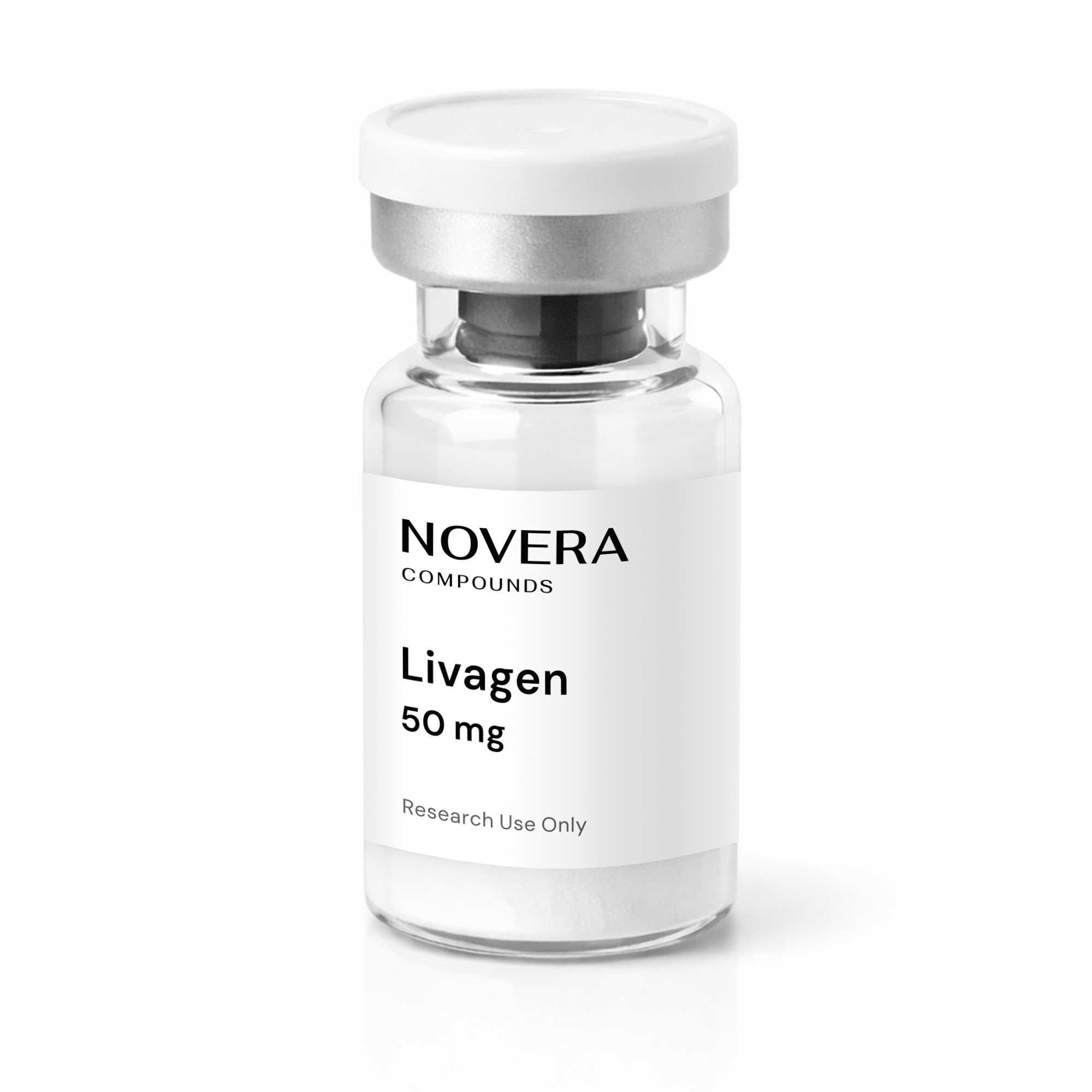
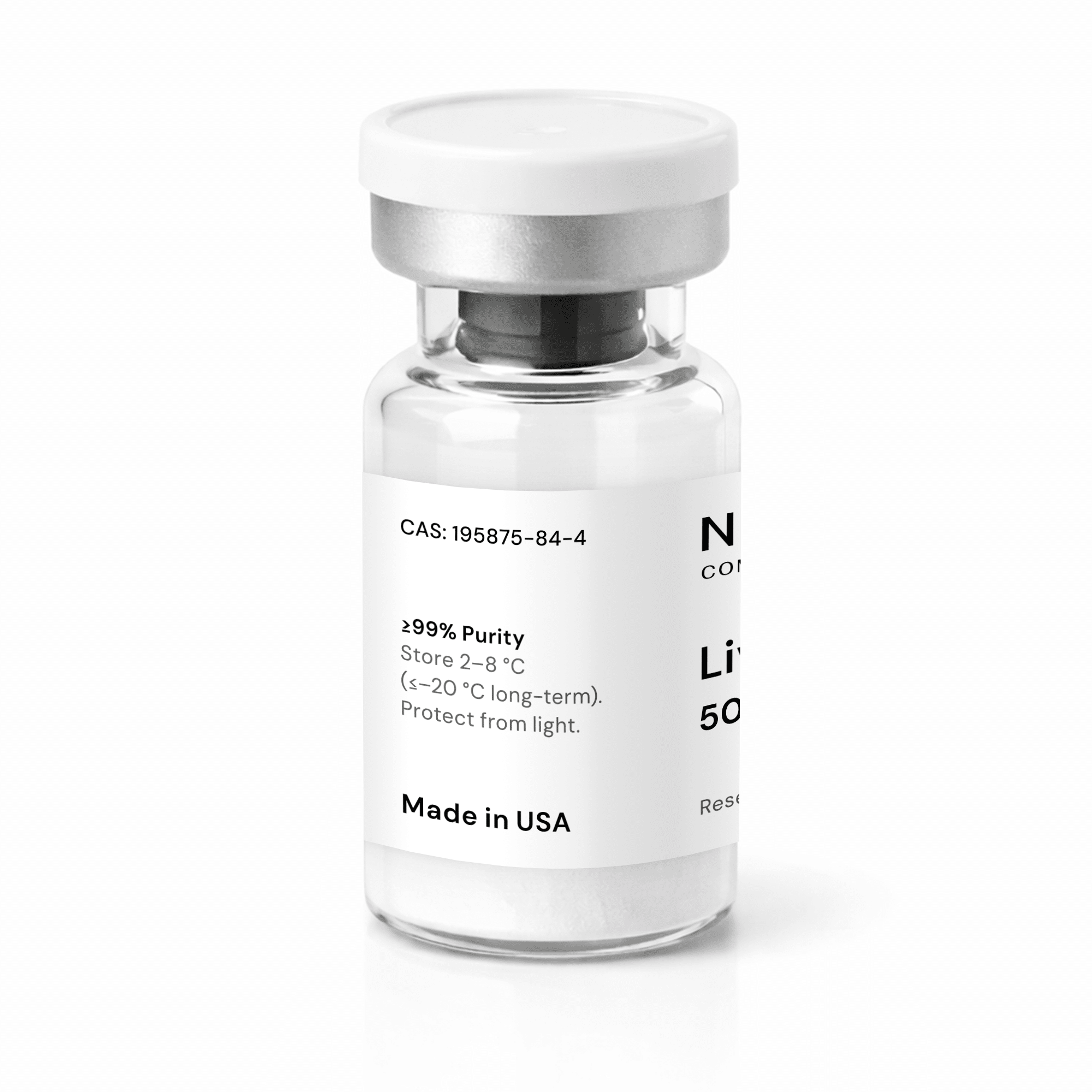
Livagen (50mg)
Coming Soon
This peptide will be available soon. Join the waitlist to be notified when it launches.
Product description
What is Livagen (50mg)?
Livagen is a short synthetic peptide belonging to a class of regulatory peptides often studied in experimental models of liver biology. It consists of the tetrapeptide sequence Lys-Glu-Asp-Ala, containing four amino acids. This small peptide fragment has attracted attention in laboratory research examining cellular regulation and gene expression in hepatic tissues. In laboratory supply formats, Livagen is commonly produced with ≥98% purity and verified using analytical techniques such as high-performance liquid chromatography (HPLC) and mass spectrometry (MS). Research literature has explored this peptide as part of broader studies investigating peptide-based regulators of cellular processes in liver tissue models.What are the key features of Livagen (50mg)?
Livagen (50mg) is typically supplied as a lyophilized peptide for laboratory handling and experimental use. Due to its small molecular structure, the peptide is frequently included in biochemical studies exploring short regulatory peptides and their interactions with cellular systems. Key features of Livagen (50mg) include:- Peptide sequence: Lys-Glu-Asp-Ala (tetrapeptide)
- Sequence length: 4 amino acids
- Subcategory: Organ-Specific & Bioregulator Peptides
- CAS Number: 195875-84-4
- Chemical Formula: C₁₈H₃₁N₅O₉
- Molecular weight: 461.46 g/mol
- Purity: Typically ≥98%, verified by HPLC
- Analytical confirmation: Mass spectrometry (MS) and chromatographic testing
- Format: Lyophilized powder supplied in a sealed research vial
How is Livagen (50mg) synthesized?
Livagen (50mg) is produced via solid-phase peptide synthesis (SPPS), a standard method for synthesizing short peptide chains with precise amino acid sequences. In this process, the four amino acids—lysine, glutamic acid, aspartic acid, and alanine—are sequentially assembled on a solid support structure to form the final tetrapeptide. After synthesis, the peptide undergoes purification, typically through high-performance liquid chromatography (HPLC), to separate the target compound from incomplete sequences or by-products. Structural confirmation is performed using mass spectrometry (MS) to verify the peptide's molecular weight and identity. The final product is lyophilized into a dry powder format to minimize degradation and facilitate laboratory handling.What is Livagen (50mg) being studied for? What are its possible benefits?
Livagen has been studied in research settings for its potential role in cellular regulation and tissue-specific peptide signaling. Some studies have examined its influence on liver cell metabolism, gene regulation, and biochemical pathways involved in hepatic cellular processes. As part of a group of short regulatory peptides associated with epigenetic research, it has also been explored in laboratory experiments related to gene expression patterns. Additional research has investigated how short peptides such as Livagen may influence cellular responses related to metabolic activity, cell repair mechanisms, and biochemical signaling in liver cells. These areas remain under investigation, and available findings are primarily from experimental or preclinical studies rather than confirmed clinical outcomes.How does Livagen (50mg) work in research studies?
In laboratory studies, experts investigate Livagen for its potential effects on cellular signaling pathways and gene expression. Small regulatory peptides may interact with cellular components involved in transcriptional regulation, prompting investigations into whether Livagen can influence certain biological pathways in cultured cells. Experimental research has examined whether peptides containing the Lys-Glu-Asp-Ala sequence can modulate intracellular regulatory mechanisms related to metabolic activity and tissue-specific protein expression. These studies typically use cell cultures or experimental models to observe biochemical responses. The exact mechanisms remain under investigation and are being explored in ongoing scientific research.What dosing information exists for Livagen (50mg)?
Information regarding Livagen dosing primarily comes from preclinical studies and experimental laboratory models. In some research contexts involving animal models, small peptide regulators, such as Livagen, have been studied at microgram-per-kilogram concentrations, depending on the experimental design and objectives. In in-vitro research, Livagen may be evaluated across varying concentration ranges within cultured cell systems to examine cellular signaling responses or metabolic markers. These concentrations differ significantly depending on laboratory protocols and experimental goals. There are no established human dosing guidelines for Livagen, as the peptide remains primarily a subject of laboratory and experimental investigation.How should Livagen (50mg) be stored and handled?
Lyophilized Livagen is typically stored at –20 °C in a controlled laboratory environment to minimize degradation and protect peptide structural integrity. The compound should be protected from light, humidity, and repeated temperature fluctuations, as these factors may affect peptide integrity. After reconstitution with a sterile laboratory solvent, the solution is generally stored at 2–8 °C for short-term use. Researchers should avoid repeated freeze-thaw cycles, which may lead to peptide degradation. Peptide integrity may vary depending on handling procedures, solvent compatibility, and laboratory practices.Where can I read more research about Livagen (50mg)?
Researchers interested in Livagen and related peptide regulators can consult several scientific databases and journals that publish studies on short regulatory peptides, liver biology, and peptide signaling. Relevant research sources include:- Timofeeva NM, Khavinson VKh, Malinin VV, Nikitina AA, Egorova VV. [Effect of peptide Livagen on activity of digestive enzymes in gastrointestinal tract and non-digestive organs in rats of different ages]. Adv Gerontol. 2005;16:92-96.
- Khavinson VKh, Lezhava TA, Monaselidze JG, et al. Effects of Livagen peptide on chromatin activation in lymphocytes from old people. Bull Exp Biol Med. 2002;134(4):389-392. doi:10.1023/a:1021924702103
- Kost NV, Sokolov OIu, Gabaeva MV, Zolotarev IuA, Malinin VV, Khavinson VKh. Vliianie novykh peptidnykh bioreguliatorov livagena i épitalona na énkefalindegradiruiushchie fermenty syvorotki krovi cheloveka [Effect of new peptide bioregulators livagen and epitalon on enkephalin-degrading enzymes in human serum]. Izv Akad Nauk Ser Biol. 2003;(4):427-429.
- Khavinson VKh, Lezhava TA, Malinin VV. Effects of short peptides on lymphocyte chromatin in senile subjects. Bull Exp Biol Med. 2004;137(1):78-81. doi:10.1023/b:bebm.0000024393.40560.05
Compliance Statement
This product is intended for laboratory research use only and is not approved for human or veterinary use.Shop with Confidence: Product Authenticity is Guaranteed
All products available at Doctor Medica shop are obtained from respective manufacturers and contain original LOT numbers Contact us if you have any questions about product LOT numbers.


