Your Cart is Empty
Start shopping

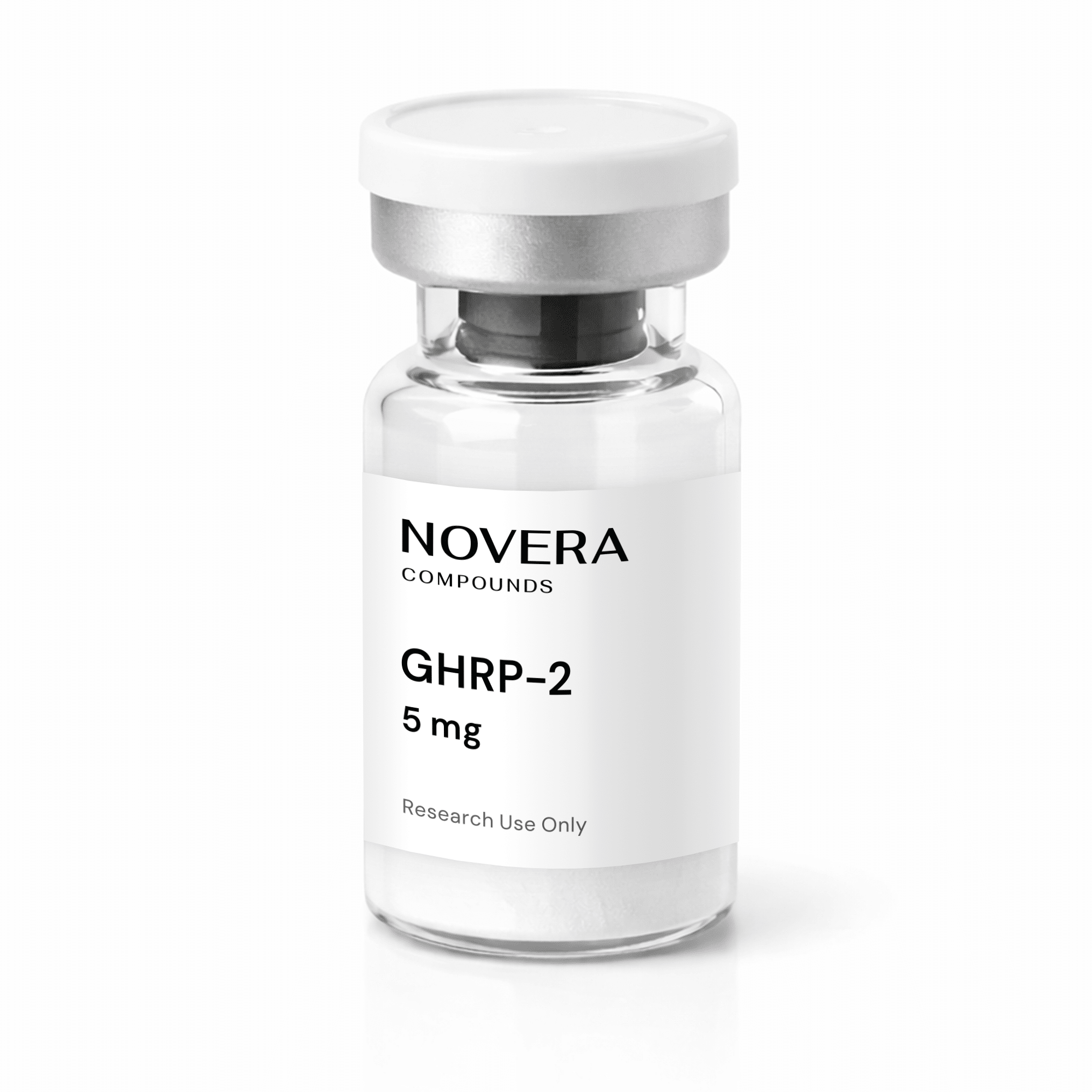
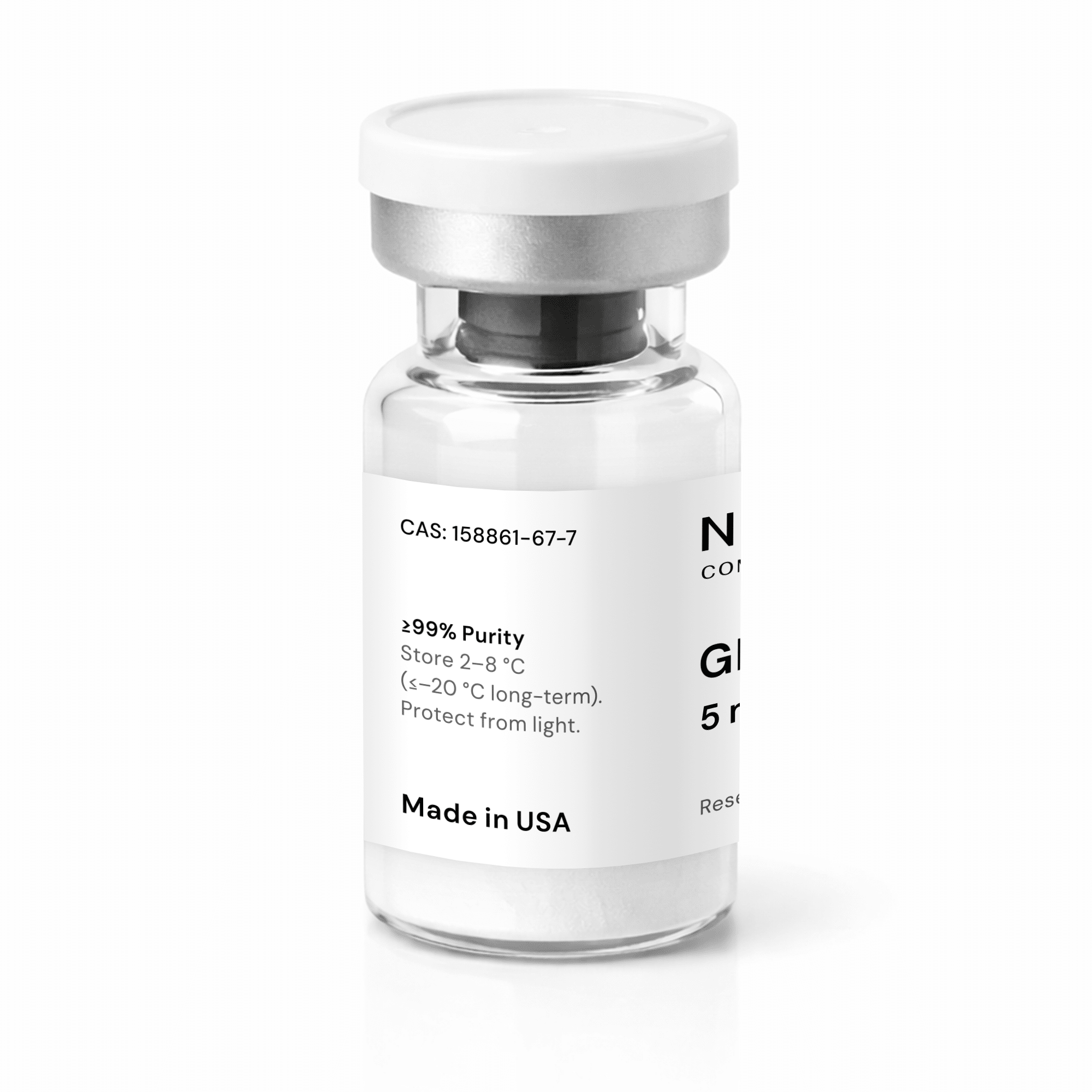
GHRP-2 (5mg)
Coming Soon
This peptide will be available soon. Join the waitlist to be notified when it launches.
Product description
What is GHRP-2 (5mg)?
GHRP-2 (Growth Hormone Releasing Peptide-2) is a synthetic hexapeptide that belongs to a group of compounds known as growth hormone secretagogues. These peptides have been extensively investigated in experimental studies for their potential to modulate growth hormone signaling pathways and related biological processes. GHRP-2 is a defined six-amino acid sequence designed to mimic peptide signals involved in endocrine communication in laboratory models. In research environments, GHRP-2 has been studied for its potential involvement in growth hormone release, metabolic regulation, and cellular signaling pathways associated with endocrine function.What are the key features of GHRP-2 (5mg)?
GHRP-2 (5mg) is typically supplied as a lyophilized peptide powder packaged in a sealed research vial. This format allows researchers to store and prepare the peptide under controlled laboratory conditions prior to experimental use. GHRP-2 has been investigated in various biochemical and physiological studies related to endocrine signaling and metabolic activity.Key Features
- Peptide classification: Synthetic growth hormone-releasing peptide
- CAS Number: 158861-67-7
- Sequence: H-D-Ala-D-2-Nal-Ala-Trp-D-Phe-Lys-NH2
- Chemical Formula: C₄₅H₅₅N₉O₆
- Molecular Weight: 817.97 g/mol
- Purity: Typically ≥98%, confirmed through HPLC and MS analysis
- Format: Lyophilized peptide supplied in a sterile research vial
- Research focus: Investigated in endocrine signaling and metabolic pathway studies
- For laboratory research use only
How is GHRP-2 (5mg) synthesized?
GHRP-2 is produced using synthetic peptide manufacturing techniques, most commonly solid-phase peptide synthesis (SPPS). This method enables precise peptide assembly by sequentially adding individual amino acids to a growing peptide chain anchored to a solid support resin. After the peptide chain is assembled, the compound is cleaved from the resin, purified, and lyophilized to create a stable powder for research use. Quality verification typically involves high-performance liquid chromatography (HPLC) to assess purity and mass spectrometry (MS) to confirm the peptide’s molecular weight and structural identity. These analytical procedures help ensure consistency and reliability across laboratory batches.What is GHRP-2 (5mg) being studied for? What are its possible benefits?
In experimental research, GHRP-2 has been studied primarily for its potential role in growth hormone signaling and metabolic regulation. Scientists have explored how peptides in this class may influence endocrine pathways involved in growth factor release, cellular metabolism, and tissue development in laboratory models. Additional research areas include investigations into protein metabolism, angiogenesis, and cellular repair mechanisms. Some studies suggest that growth hormone secretagogues may interact with signaling pathways related to tissue growth and metabolic balance. These biological responses are still under investigation, and findings are largely derived from preclinical experiments and controlled laboratory studies rather than clinical applications.How does GHRP-2 (5mg) work in research studies?
In laboratory studies, GHRP-2 is investigated for its ability to modulate growth hormone signaling pathways. GHRP-2 is studied as a selective agonist of the growth hormone secretagogue receptor (GHS-R1a), also known as the ghrelin receptor, in experimental models. These signaling interactions may affect processes such as protein synthesis, metabolic activity, and cellular growth responses in experimental models. Laboratory observations suggest that peptides like GHRP-2 may influence intracellular signaling pathways involved in metabolic regulation and cellular communication. However, these mechanisms continue to be examined in preclinical studies, and the full scope of their biological activity remains an active area of research.What dosing information exists for GHRP-2 (5mg)?
Scientific literature describing GHRP-2 primarily reports concentrations used in preclinical and laboratory studies. In certain animal experiments, the peptide has been studied at doses ranging from approximately 1–10 µg/kg to evaluate its influence on growth hormone signaling and metabolic activity. In in-vitro studies, researchers have examined GHRP-2 at concentrations within the nanomolar to micromolar range, depending on the cell type and experimental design. These values represent conditions used in laboratory investigations and should not be interpreted as recommended dosing levels. At present, no established dosing guidelines exist for human or veterinary use.How should GHRP-2 (5mg) be stored and handled?
Store GHRP-2 (5mg) at –20 °C in a sealed, airtight container, protected from light and moisture. If reconstituted for experimental use, short-term storage at 2–8 °C is recommended. Avoid repeated freeze–thaw cycles, as these may reduce peptide stability. Refer to the supplier's COA for lot-specific stability data. Proper laboratory handling procedures, including sterile technique and accurate volumetric measurement, are recommended to ensure experimental consistency.Where can I read more research about GHRP-2 (5mg)?
- Kageyama K, Kushibiki M, Hanada K, Sakihara S, Yasujima M, Suda T. Growth hormone-releasing peptide-2 stimulates secretion and synthesis of adrenocorticotropic hormone in mouse pituitary. Regul Pept. 2009;158(1-3):116-120. doi:10.1016/j.regpep.2009.07.018
- Hu R, Wang Z, Peng Q, et al. Effects of GHRP-2 and Cysteamine Administration on Growth Performance, Somatotropic Axis Hormone and Muscle Protein Deposition in Yaks (Bos grunniens) with Growth Retardation. PLoS One. 2016;11(2):e0149461. Published 2016 Feb 19. doi:10.1371/journal.pone.0149461
- Laferrère B, Hart AB, Bowers CY. Obese subjects respond to the stimulatory effect of the ghrelin agonist growth hormone-releasing peptide-2 on food intake. Obesity (Silver Spring). 2006;14(6):1056-1063. doi:10.1038/oby.2006.121
- Arvat E, Maccario M, Di Vito L, et al. Endocrine activities of ghrelin, a natural growth hormone secretagogue (GHS), in humans: comparison and interactions with hexarelin, a nonnatural peptidyl GHS, and GH-releasing hormone. J Clin Endocrinol Metab. 2001;86(3):1169-1174. doi:10.1210/jcem.86.3.7314
- Petersenn S, Rasch AC, Penshorn M, Beil FU, Schulte HM. Genomic structure and transcriptional regulation of the human growth hormone secretagogue receptor. Endocrinology. 2001;142(6):2649-2659. doi:10.1210/endo.142.6.8184
Compliance Statement
This product is intended for laboratory research use only and is not approved for human or veterinary use.Shop with Confidence: Product Authenticity is Guaranteed
All products available at Doctor Medica shop are obtained from respective manufacturers and contain original LOT numbers Contact us if you have any questions about product LOT numbers.


