Your Cart is Empty
Start shopping

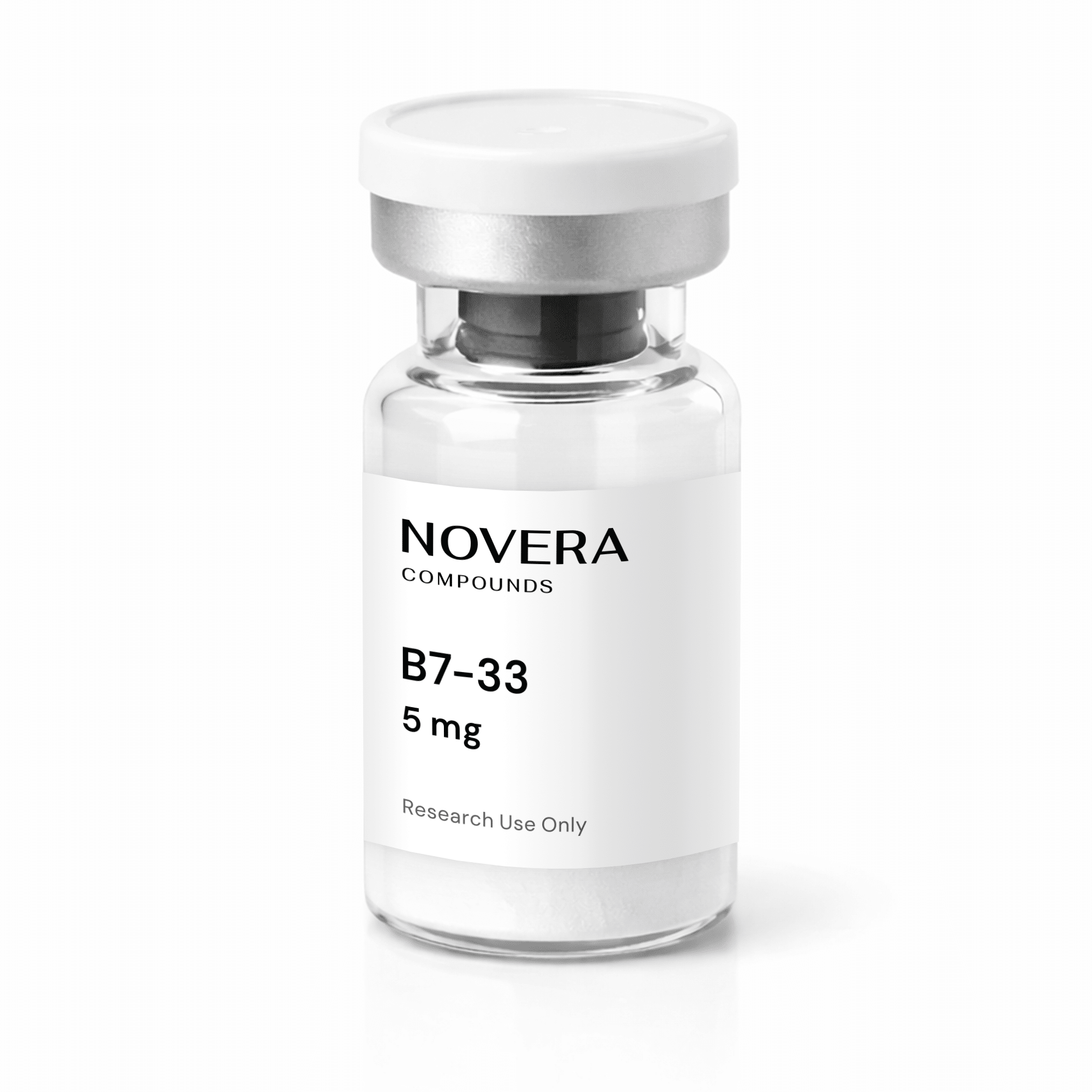
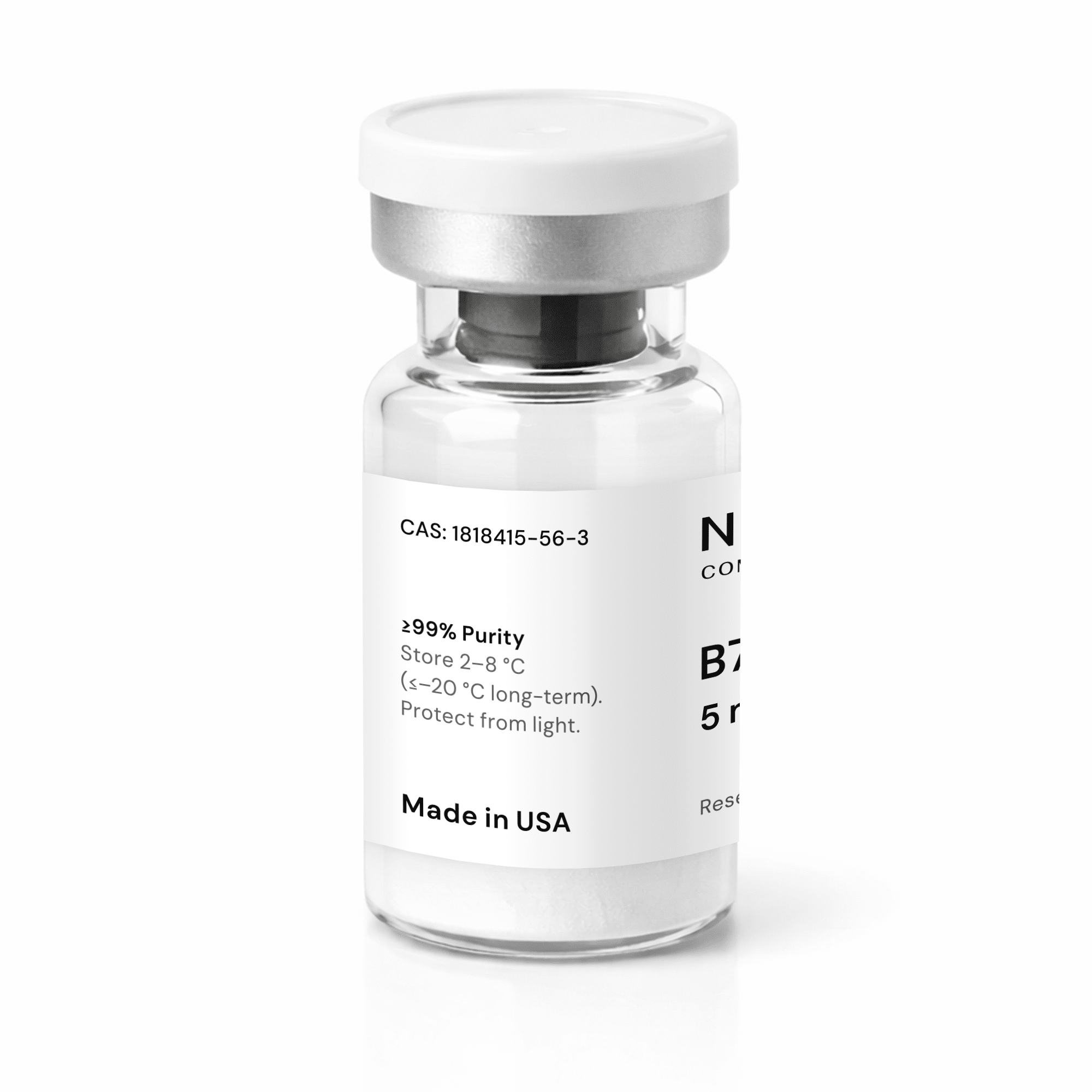
B7-33
Coming Soon
This peptide will be available soon. Join the waitlist to be notified when it launches.
Product description
What is B7-33?
B7-33 is a synthetic, single-chain peptide derived from the B-chain region of human relaxin-2 (H2-relaxin). It is classified as a healing and regenerative peptide and has been studied as a functionally selective analog designed to replicate certain extracellular matrix and vascular signaling properties of relaxin while limiting broader pathway activation.- CAS Number: 1818415-56-3
- Chemical Formula: C₁₃₁H₂₂₉N₄₁O₃₆S
- Molecular Weight: 2986.54 g/mol
- Peptide Sequence: Val-Ile-Lys-Leu-Ser-Gly-Arg-Glu-Leu-Val-Arg-Ala-Gln-Ile-Ala-Ile-Ser-Gly-Met-Ser-Thr-Trp-Ser-Lys-Arg-Ser-Leu-NH₂
What are the key features of B7-33?
B7-33 is supplied as a lyophilized peptide powder, which helps preserve its structural integrity during storage and transport. It is intended for controlled laboratory research in cellular assays and preclinical models. Key features include:- 27-amino acid synthetic relaxin analog
- High purity (commonly ≥98–99%)
- Verified by HPLC and mass spectrometry (MS)
- Lyophilized vial format for precise reconstitution
- Studied in extracellular matrix and fibroblast signaling models
- Suitable for in-vitro and animal research applications
- Manufactured under controlled laboratory standards for reproducibility
- For laboratory research use only
How is B7-33 synthesized?
B7-33 is produced using solid-phase peptide synthesis (SPPS), a standard method that allows stepwise assembly of the peptide chain with high accuracy. Unlike full-length relaxin-2, which contains two peptide chains linked by disulfide bonds, B7-33 is engineered as a linear, single-chain analog derived from the relaxin B-chain region. After synthesis, the crude peptide is purified by reverse-phase HPLC to achieve high homogeneity. The peptide’s molecular identity and molecular weight are confirmed using mass spectrometry (MS). Certificates of Analysis (COAs) typically confirm sequence fidelity and analytical results, ensuring batch consistency for research use.What is B7-33 being studied for? What are its possible benefits?
B7-33 has been studied in preclinical models investigating fibrosis, cardiovascular remodeling, and vascular function. Research has focused on its role in regulating extracellular matrix turnover and fibroblast activity in cardiac and pulmonary injury models. Areas under investigation include:- Modulation of collagen deposition in fibrotic tissues
- Regulation of matrix metalloproteinase activity
- Influence on fibroblast activation markers
- Effects on endothelial signaling and vascular tone
- Evaluation in ischemia-reperfusion and biomaterial-associated fibrosis models
How does B7-33 work in research studies?
In laboratory settings, B7-33 is studied for its ability to selectively activate intracellular signaling pathways associated with relaxin biology. It is often referred to as a biased agonist because it preferentially stimulates certain signaling cascades while minimizing others. Research suggests that B7-33 may:- Promote pathways involved in extracellular matrix turnover
- Support the regulation of fibroblast activation
- Influence signaling associated with nitric oxide in vascular models
- Modulate growth factor and inflammatory signaling networks
What dosing information exists for B7-33?
Dosing information for B7-33 is derived from preclinical research. In murine models of cardiac ischemia-reperfusion injury, B7-33 has been studied at approximately 0.25 mg/kg administered intraperitoneally, often twice daily over several days. In pulmonary fibrosis models, intranasal administration at similar dose ranges has been evaluated over a two-week period. Other vascular studies have reported intravenous dosing in microgram-per-kilogram ranges. In cell-based assays, nanomolar concentrations have been used to assess pathway activation and extracellular matrix markers. These dosing regimens are model-specific and designed for controlled experimental conditions. No established human dosing guidelines exist for B7-33.How should B7-33 be stored and handled?
Lyophilized B7-33 should be stored at ≤–20 °C for long-term preservation. The peptide should be protected from light and moisture to maintain stability. When stored properly, the shelf life may extend up to 24 months. Researchers must always use aseptic handling procedures. Additionally, temporary exposure to room temperature during shipping is generally acceptable for lyophilized material.Where can I read more research about B7-33?
The following peer-reviewed publications provide foundational data on B7-33 and its biological activity:- Hossain MA, Kocan M, Yao ST, et al. A single-chain derivative of the relaxin hormone is a functionally selective agonist of the G protein-coupled receptor, RXFP1. Chem Sci. 2016;7(6):3805-3819. doi:10.1039/c5sc04754d
- Devarakonda T, Mauro AG, Guzman G, et al. B7-33, a Functionally Selective Relaxin Receptor 1 Agonist, Attenuates Myocardial Infarction-Related Adverse Cardiac Remodeling in Mice. J Am Heart Assoc. 2020;9(8):e015748. doi:10.1161/JAHA.119.015748
- Wołowiec Ł, Jaśniak A, Osiak-Gwiazdowska J, et al. Long-acting relaxin analogues: a novel tool in cardiology. Frontiers in Pharmacology. 2025;16:1626469. doi:10.3389/fphar.2025.1626469
- Marshall SA, O’Sullivan K, Ng HH, et al. B7-33 replicates the vasoprotective functions of human relaxin-2 (serelaxin). European Journal of Pharmacology. 2017;807:190-197. doi:10.1016/j.ejphar.2017.05.005
- Welch NG, Mukherjee S, Hossain MA, et al. Coatings Releasing the Relaxin Peptide Analogue B7-33 Reduce Fibrotic Encapsulation. ACS Appl Mater Interfaces. 2019;11(49):45511-45519. doi:10.1021/acsami.9b17859
Compliance Statement
This product is intended for laboratory research use only and is not approved for human or veterinary use.Shop with Confidence: Product Authenticity is Guaranteed
All products available at Doctor Medica shop are obtained from respective manufacturers and contain original LOT numbers Contact us if you have any questions about product LOT numbers.


