Your Cart is Empty
Start shopping

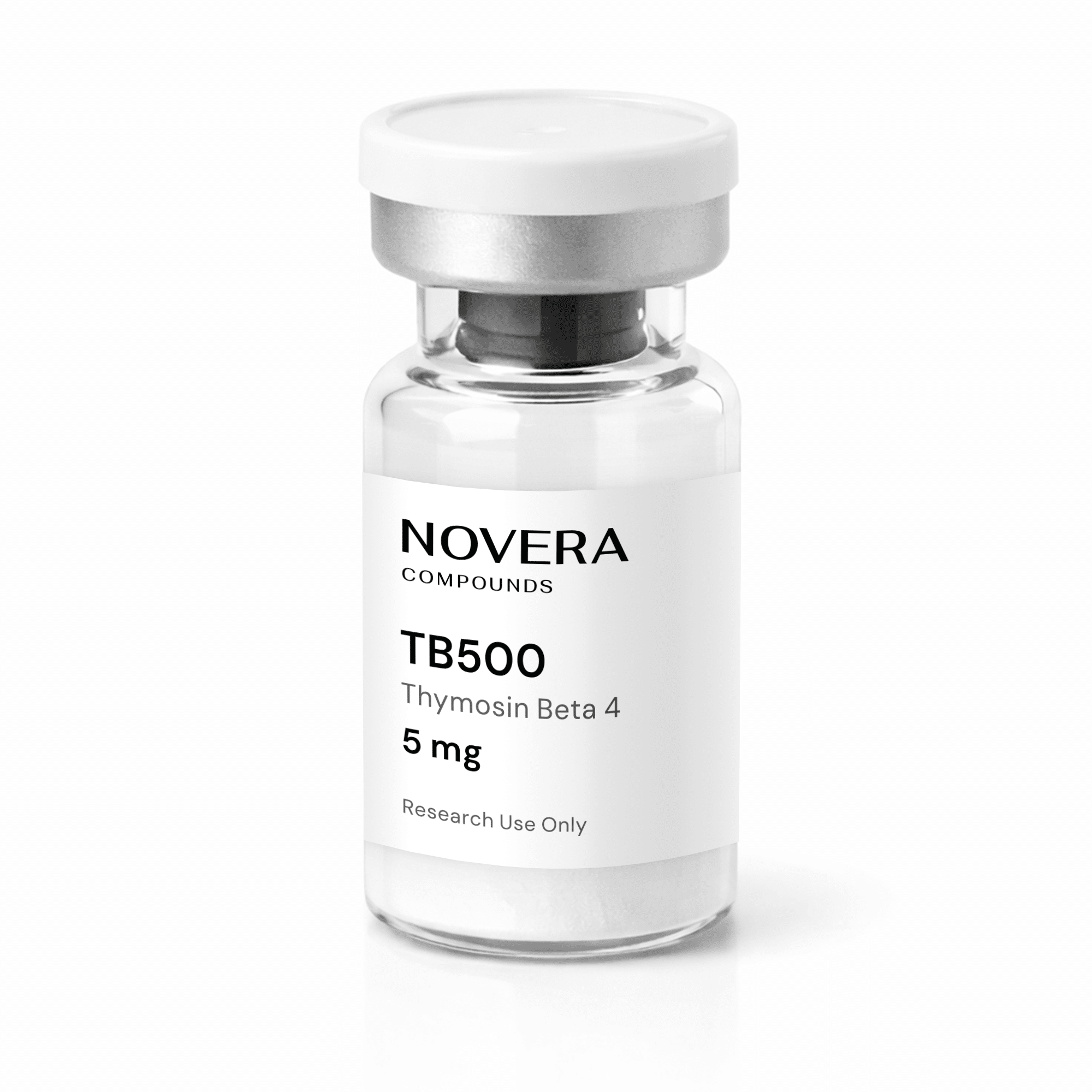
Thymosin Beta 4 (TB500) (5mg)
Coming Soon
This peptide will be available soon. Join the waitlist to be notified when it launches.
Product description
What is Thymosin Beta 4 (TB500) (5mg)?
Thymosin Beta 4 (TB500) (5mg) is a synthetic 43-amino acid peptide corresponding to the natural thymosin beta-4 sequence, a protein classically known as an actin-binding factor investigated within the healing & regenerative peptides category for its roles in cytoskeletal organization and tissue regeneration. The TB500 peptide has been extensively studied in preclinical research to investigate its role in cell migration, angiogenesis (formation of new blood vessels), and tissue remodeling processes. The peptide has a molecular weight of approximately 4963 g/mol (molecular formula C₂₁₂H₃₅₀N₅₆O₇₈S) and is produced as a purified laboratory compound with high structural fidelity to native thymosin beta-4. It is available in both 5 mg and 10 mg vial formats to accommodate varying research scales. Notably, research-grade preparations are supplied with ≥99% purity, verified through analytical methods such as HPLC (high-performance liquid chromatography) and mass spectrometry. Researchers exploring TB500 rely on its consistency and stability for precise, reproducible experimental outcomes in controlled laboratory settings.What are the key features of Thymosin Beta 4 (TB500) (5mg)?
Thymosin Beta 4 (TB500) (5mg) is supplied as a lyophilized (freeze-dried) powder intended for precise reconstitution and controlled laboratory research applications. The peptide maintains high quality standards and consistent specifications across manufacturing batches, supporting varied experimental designs in cell biology and preclinical research. Key features include:- 99% purityconfirmed through HPLC and mass spectrometry analysis
- Stable lyophilized powder formatfor extended storage at −20 °C or lower
- Structurally consistent 43-amino acid sequencecorresponding to native thymosin beta-4
- Suitable for in vitro and preclinical research environmentsincluding cell culture and animal models
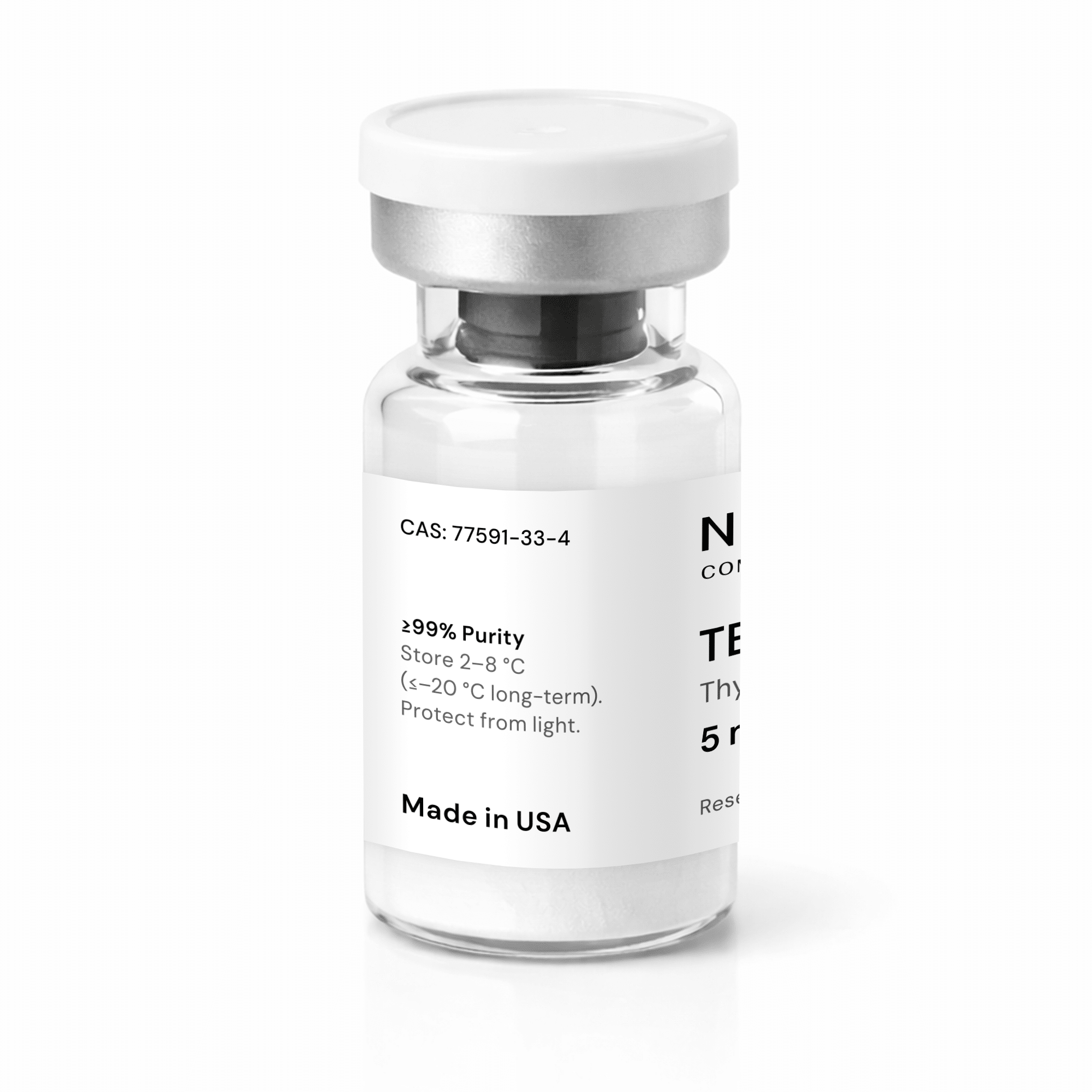
- CAS number 77591-33-4with verified molecular weight (4963 Da)
- Comprehensive analytical documentationtypically accompanying each batch for quality assurance
- For laboratory research use only.
How is Thymosin Beta 4 (TB500) (5mg) synthesized?
Thymosin Beta 4 (TB500) (5mg) is synthesized using solid-phase peptide synthesis (SPPS), a well-established technique where individual amino acids are added sequentially to a resin-bound backbone. This methodology enables precise sequence control and accurate replication of the complete 43-amino acid thymosin beta-4 sequence with high fidelity. Once peptide assembly is complete, the material undergoes cleavage from the resin support, followed by purification using reversed-phase HPLC to remove incomplete sequences and synthesis by-products. Furthermore, mass spectrometry analysis confirms molecular weight accuracy and peptide identity. These rigorous manufacturing and analytical steps ensure the TB500 peptide maintains consistency, purity, and structural integrity, making it reliable for preclinical studies and mechanistic research applications.What is Thymosin Beta 4 (TB500) being studied for? What are its possible benefits?
TB500 is being investigated in various preclinical models focused on cytoskeletal dynamics, cellular motility, and tissue-remodeling processes. Researchers have examined its potential role in multiple research areas:- Cell migration and adhesion phenotyping, including scratch assays and transwell migration assays
- Angiogenesis and vascular biology, investigating endothelial cell behavior and new blood vessel formation
- Tissue repair and wound healing, examining cellular responses in injury models
- Cytoskeletal remodeling, particularly actin polymerization dynamics and stress fiber organization
- Oxidative stress signaling, evaluating cell viability and inflammatory mediator responses under defined stressors
- Neural tissue support, including spinal cord injury models and neural stem/progenitor cell behavior
How does Thymosin Beta 4 (TB500) (5mg) work in research studies?
In laboratory settings, Thymosin Beta 4 (TB500) is believed to interact with actin, a fundamental protein that regulates cellular structure and movement. Research has shown that TB500 binds to G-actin (globular actin), preventing its polymerization into F-actin (filamentous actin) filaments—a process called actin sequestration. This interaction influences the available monomer pool for filament assembly, thereby regulating cellular behaviors dependent on cytoskeletal remodeling. Preclinical studies explore how TB500-mediated actin regulation affects multiple downstream processes, including cell migration to injury sites, endothelial cell proliferation and tube formation, and extracellular matrix (ECM) remodeling. Research has also documented TB500's association with angiogenic transcriptional programs, including changes in growth factor signaling (such as VEGF-related pathways) and stress-response pathway modulation. Researchers also explore these areas in studies involving GHK-Cu, another compound examined in connection with extracellular matrix signaling and angiogenesis. These mechanisms remain under ongoing investigation and are theoretical rather than clinically validated.What dosing information exists for Thymosin Beta 4 (TB500) (5mg)?
Dosing information for Thymosin Beta 4 (TB500) (5mg) derives strictly from preclinical research in animal models and in vitro cell culture studies. Animal studies have employed dose-dependent approaches with concentrations varying according to experimental design and research objectives. In vitro cellular research typically uses nanomolar to micromolar concentrations (generally 0.1–100 nM range), depending on the cell type being investigated and specific assays employed. The TB500 10 mg vial format is commonly reconstituted to standardized concentrations (typically 0.5–1.0 mg/mL) for consistent laboratory dosing across replicate experiments. It is essential to note that no human dosing guidelines exist for TB500, and all available dosing information applies exclusively to preclinical animal models and in vitro assays. Researchers should consult published preclinical protocols for specific dose-response relationships relevant to their experimental design.How should Thymosin Beta 4 (TB500) (5mg) be stored and handled?
TB500 should be stored as a lyophilized powder at −20 °C for long-term stability, protected from light, moisture, and temperature fluctuations. Additionally, shelf-life of TB500 can reach up to 24 months in proper storage environment. Short-term storage at 2–8 °C is acceptable for limited periods (typically 24–48 hours) if immediate use is planned. Vials should remain sealed until use and stored in cool, dry locations away from direct light and humidity. Once reconstituted with bacteriostatic water or an appropriate sterile diluent, TB500 solutions should be refrigerated at 2–8 °C and not frozen. Reconstituted solutions have limited stability; researchers should use them within 7–14 days, depending on diluent selection and storage conditions, or prepare fresh solutions for each experiment.Handling Precautions
- Avoid repeated freeze-thaw cycles, which compromise peptide integrity and degrade structure
- Protect from elevated temperatures above 30 °C (86 °F)
- Minimize light exposure by storing in original vials or amber-colored opaque containers
- Use aseptic, sterile procedures during all reconstitution and handling steps
- Keep the peptide desiccated (dry) to prevent moisture-related degradation
- Gently swirl vials to dissolve lyophilized material; do not shake vigorously
- Keep reconstituted solutions clearly labeled with content, concentration, preparation date, and storage conditions
Where can I read more research about TB500 (Thymosin B4 Acetate)?
Researchers seeking additional peer-reviewed literature on thymosin beta 4 and TB500 may refer to the following credible sources:- Xing Y, Ye Y, Zuo H, Li Y. Progress on the Function and Application of Thymosin β4. Front Endocrinol (Lausanne). 2021;12:767785. Published 2021 Dec 21. doi:10.3389/fendo.2021.767785
- Guzmán F, Aróstica M, Román T, et al. Peptides, solid-phase synthesis and characterization: Tailor-made methodologies. Electronic Journal of Biotechnology. 2023;64:27-33. doi:https://doi.org/10.1016/j.ejbt.2023.01.005
- TB-500 - Peptide Research | Pep-Pedia. Pep-Pedia. Published 2016. https://pep-pedia.org/peptides/tb-500
- The Journal of Peptide Science. What Does TB-500 Do? Mechanisms of Action | The Journal of Peptide Science. The Journal of Peptide Science. Published 2025. https://www.thejops.com/peptides/tb-500/does.html
Compliance Statement
This product is intended for laboratory research use only and is not approved for human or veterinary use.Shop with Confidence: Product Authenticity is Guaranteed
All products available at Doctor Medica shop are obtained from respective manufacturers and contain original LOT numbers Contact us if you have any questions about product LOT numbers.


