Your Cart is Empty
Start shopping

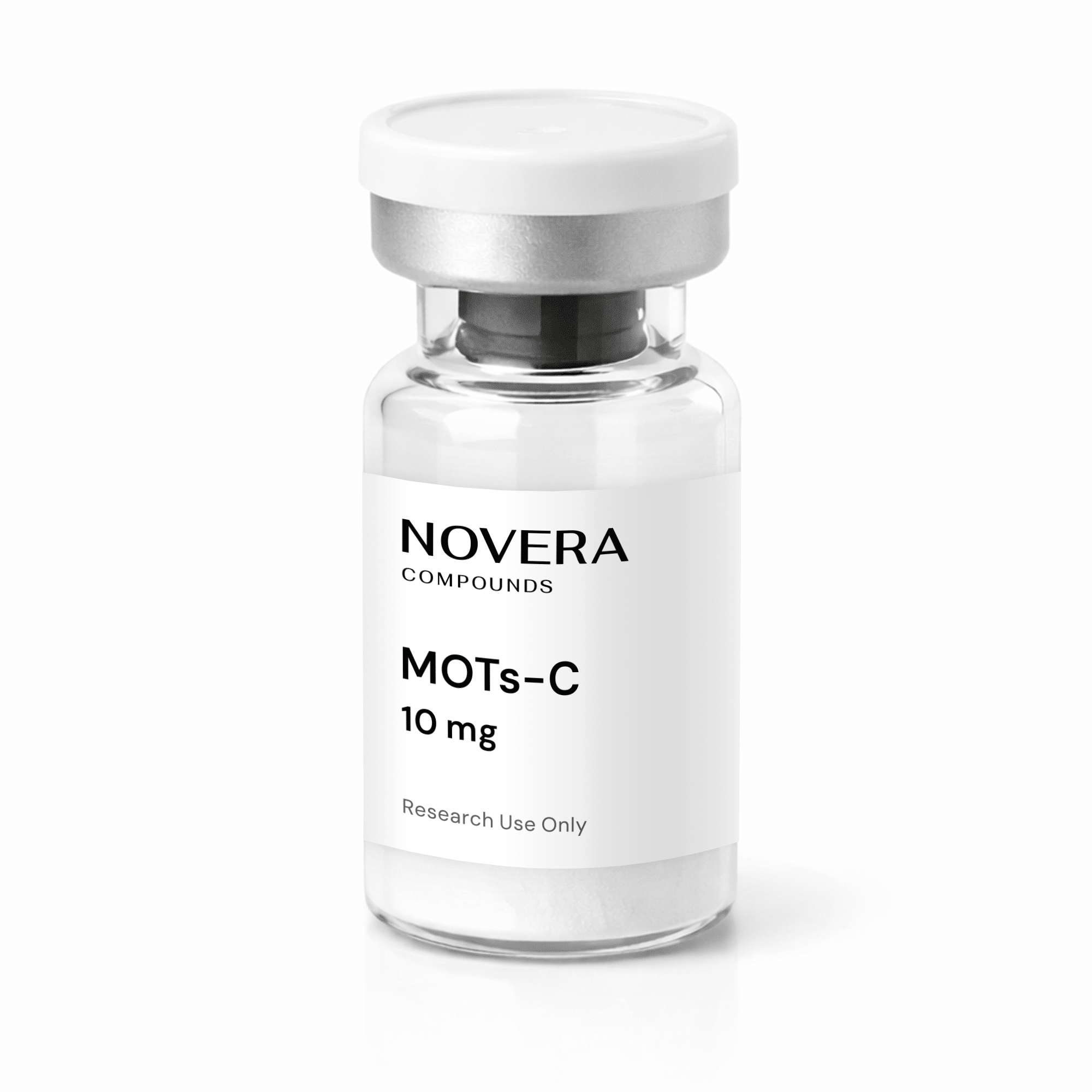

MOTs-C (10mg)
Tier
| Packs | Discount (%) | For Each |
|---|---|---|
| 1 - 5 | — | $86.00 |
| 6 - 10 | 10.47 % | $77.00 |
| 11 - 20 | 19.77 % | $69.00 |
| 21+ | 27.91 % | $62.00 |
Product description
What is MOTS-c?
MOTS-c (mitochondrial open reading frame of the 12S rRNA-c) is a 16-amino acid mitochondrial-derived peptide encoded within the 12S rRNA region of mitochondrial DNA.- With a molecular weight of 2174.64 g/mol(approximately 17 kDa) and the amino acid sequence Met-Arg-Trp-Gln-Glu-Met-Gly-Tyr-Ile-Phe-Tyr-Pro-Arg-Lys-Leu-Arg, this peptide belongs to a class of regulatory molecules known as mitochondrial-derived peptides (MDPs)that have been extensively studied for their roles in metabolic signaling and cellular adaptation under stress conditions.
What are the key features of MOTS-c?
Those planning to buy MOTS c for laboratory workflows benefit from its well-characterized biochemical profile and extensive research literature. MOTS-c is produced as a high-purity research material with consistent composition and verified identity. Its standardized packaging in lyophilized powder format is available in 5 mg and 10 mg vial options suited for controlled handling and experimental reproducibility. Researchers frequently select this peptide because it is comprehensively characterized and widely referenced in metabolic and aging research. Key features include:- 99% purity, confirmed by HPLC and mass spectrometry with no added excipients
- MOTS-c 10 mg vial format(also available in 5 mg) — Standard lyophilized powder vials suitable for controlled laboratory protocols
- Mitochondrial-derived sequence— Encoded within the 12S rRNA region, supporting research on mitochondrial genome-encoded signaling molecules
- AMPK activation pathway— Investigated for its influence on AMPK-dependent metabolic signaling and stress response mechanisms
- Stable lyophilized form— Freeze-dried for long-term stability at −20 °C with minimal degradation under proper storage conditions
- Nuclear translocation capability— Researched for its stress-responsive ability to relocate to the nucleus and regulate gene expression
- For laboratory research use only
How is MOTS-c synthesized?
Most laboratory formulations of MOTS-c are produced via solid-phase peptide synthesis (SPPS), a precisely controlled chemical method that enables accurate replication of the native 16-amino acid sequence and ensures rigorous control over purity, composition, and structural integrity. Following synthesis, comprehensive material validation includes HPLC confirmation of purity and mass spectrometry verification of molecular identity to ensure structural accuracy. Synthetic production enables consistent batch-to-batch quality and eliminates biological contaminants inherent to extraction-based methods. After analytical validation, the peptide is lyophilized into a stable powder formulation suitable for reconstitution in laboratory experiments. This synthetic approach maintains biochemical uniformity across studies, enabling researchers to work with a well-defined mitochondrial-derived compound with characterized purity and stability.What is MOTS-c being studied for? What are its possible benefits?
MOTS-c investigations in research have focused on its role as a metabolism-regulating signaling peptide originating from mitochondrial DNA. Research has examined its involvement in cellular energy balance, nutrient stress responses, antioxidant signaling, and adaptive metabolic regulation across multiple biological contexts. Studies often explore MOTS-c's ability to translocate to the nucleus and influence gene expression regions associated with cellular protection and stress adaptation. Additional research areas include mitochondrial-nuclear communication, glucose utilization pathways, lipid metabolism, skeletal muscle biology, and metabolic flexibility during physiological stress. Preclinical models have evaluated how MOTS-c mitochondrial peptide may contribute to maintaining metabolic homeostasis and adaptive responses under challenging conditions, including:- Nutrient deprivation
- Oxidative stress
- Metabolic perturbation
How does MOTS-c work in research studies?
In laboratory investigations, MOTS-c activity is described in the context of metabolic signaling and stress adaptation. Studies suggest the peptide responds to nutrient depletion, energy imbalance, or oxidative stress by activating the AMPK signaling pathway, a central energy-sensing system that coordinates cellular metabolic responses. Research indicates MOTS-c supports adaptive pathways by influencing gene expression related to antioxidant defense, protein synthesis, and metabolic stress resistance through AMPK-dependent mechanisms. Meanwhile, several investigations have examined how MOTS-c interacts with signaling networks involved in AMPK activation, mitochondrial efficiency, cellular energy homeostasis, and nuclear gene regulation. The peptide's ability to translocate from mitochondria to the nucleus under stress conditions enables it to directly regulate nuclear gene expression associated with stress response and cellular protection. This research helps clarify mitochondrial-nuclear cross-talk and provides mechanistic insight into how mitochondrial-encoded peptides participate in adaptive cellular responses, though these mechanisms remain under active investigation with outcomes varying by experimental model.What dosing information exists for MOTS-c?
Preclinical research examining MOTS-c has employed various dosing protocols depending on research design and experimental endpoint. Published studies have evaluated:- Intraperitoneal administration:Ranging from 0.5 to 50 mg/kg, depending on study model and duration
- Subcutaneous administration:Variable dosing based on study design and endpoints evaluated
- In-vitro cellular studies:Concentrations ranging from micromolar to nanomolar levels, depending on cell type and measurement parameters
How should MOTS-c be stored and handled?
Unreconstituted Lyophilized Peptide:- Storage temperature:−20 °C (protected from light and moisture) for routine storage; −80 °C for extended long-term preservation
- Storage environment:Sealed, dry container protected from heat, moisture, and direct light exposure
- Expected stability:Lyophilized peptide remains stable for extended periods under proper cold-storage conditions
- Preparation:Typically reconstituted using sterile water or phosphate-buffered saline
- Short-term storage:2–8 °C (standard refrigeration) for immediate use
- Long-term storage:−80 °C freezing for extended preservation
- Handling precaution:Minimize repeated freeze-thaw cycles, as they can compromise peptide integrity and reduce biological activity
- Aseptic technique:Standard laboratory safety procedures and sterile technique should be followed during all experimental preparation steps
Where can I read more research about MOTS-c?
Researchers can access peer-reviewed studies and detailed scientific discussions through major biomedical databases. Foundational and contemporary studies on MOTS-c biochemistry, mitochondrial signaling, metabolic mechanisms, and preclinical applications are available via:- Cuyàs E, Verdura S, Martin-Castillo B, Menendez JA; METTEN study group. Circulating levels of MOTS-c in patients with breast cancer treated with metformin. Aging (Albany NY). 2022;15(4):892-897. doi:10.18632/aging.204423
- Lee C, Kim KH, Cohen P. MOTS-c: A novel mitochondrial-derived peptide regulating muscle and fat metabolism. Free Radic Biol Med. 2016;100:182-187. doi:10.1016/j.freeradbiomed.2016.05.015
- Lee C, Zeng J, Drew BG, et al. The mitochondrial-derived peptide MOTS-c promotes metabolic homeostasis and reduces obesity and insulin resistance. Cell Metab. 2015;21(3):443-454. doi:10.1016/j.cmet.2015.02.009
- Yang B, Yu Q, Chang B, et al. MOTS-c interacts synergistically with exercise intervention to regulate PGC-1α expression, attenuate insulin resistance and enhance glucose metabolism in mice via AMPK signaling pathway. Biochim Biophys Acta Mol Basis Dis. 2021;1867(6):166126. doi:10.1016/j.bbadis.2021.166126
- Reynolds JC, Lai RW, Woodhead JST, et al. MOTS-c is an exercise-induced mitochondrial-encoded regulator of age-dependent physical decline and muscle homeostasis. Nat Commun. 2021;12(1):470. Published 2021 Jan 20. doi:10.1038/s41467-020-20790-0
Compliance Statement
This product is intended for laboratory research use only and is not approved for human or veterinary use.Shop with Confidence: Product Authenticity is Guaranteed
All products available at Doctor Medica shop are obtained from respective manufacturers and contain original LOT numbers Contact us if you have any questions about product LOT numbers.


